Leaming Canyon, Santa Clarita, California
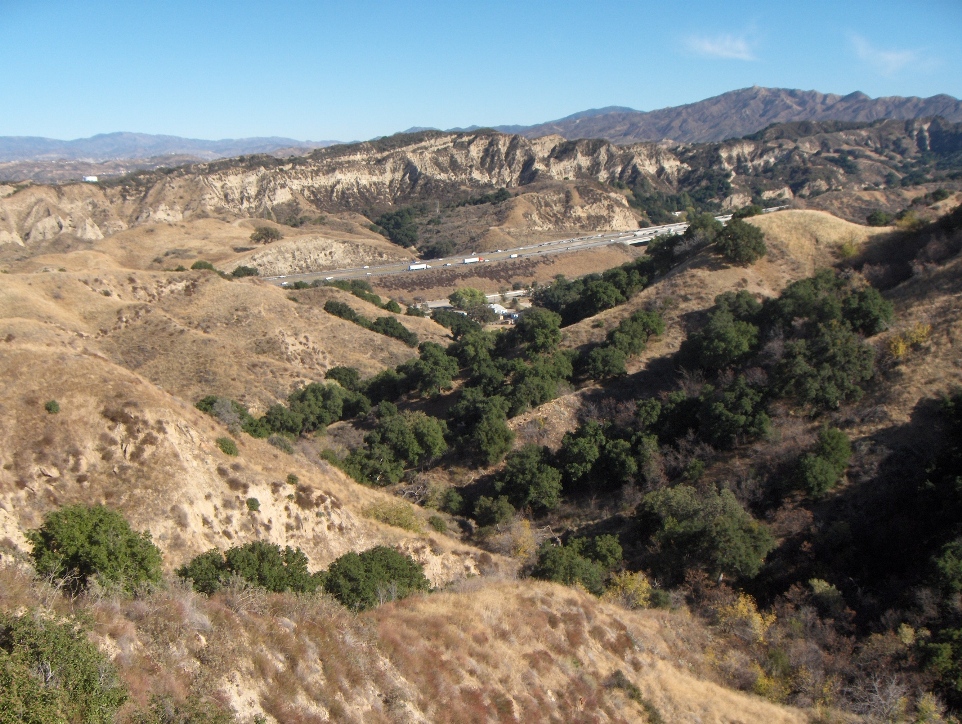
Looking northeast down Leaming Canyon with Interstate 5 in the distance (12/6/2008)
Leaming Canyon is located between Wiley and Rice Canyons. There is an old road that runs a little way into the canyon stopping at a crib dam. Most of the mouth area appears to be privately owned. The canyon does not extend as far south as the others and is not as deep. There is no evidence of any oil seeps or any oil drilling activity.
In early 1865 Christopher Leaming filed a claim for 160 acres in the canyon that would in the future be named after him. See here for that claim.
Based on his court probate case (Los Angeles Probate: Second Series, Case Number 07772) after his death and the book Mayflower Pilgrim Descendants in Cape May County, New Jersey, it can be determined that his father was Humphrey Leaming (1780 NJ-1851 NJ). Humphrey was married to Mary Stites on January 19, 1809. At the time of Christopher's death, he had two brothers and one sister still alive. They were Humphrey (10/12/1813 NJ-11/7/1892, Rachel Ludlam (11/30/1815 NJ-12/21/1894), and Phillip S. (5/30/1819 NJ-12/28/1890). Leaming was never married.
Christopher was born on July 1, 1827, in New Jersey and died in Newhall on May 8, 1888. The Los Angeles County Register of Deaths listed his cause of death as "pareticus", an epilepsy from a brain lesion. Leaming's body was shipped back east to his hometown in New Jersey where he was buried in the Cold Spring Presbyterian Cemetery in Cape May.
In 1850, he was living in New Jersey with his parents (1850 US Census). I'm not sure when he arrived in California. I couldn't find him on the 1852 California or the 1860 US census. He was commissioned a Notary Public in 1862 (Sacramento Daily Union, October 10, 1862).
In the early 1860's, Leaming was involved with copper mining in the Soledad Mining District. He was living in Ravenna. In the Daily Alta California, September 11, 1862, George Y. Clarke writes: "Arriving here [Ravenna City, Soledad Mining District] I found a good number of citizens: men with families and about thirty children. N.B. Johnson, Goe. Farborough, and C. Leaming are some of the pioneers of the [copper with gold and silver] mines." "Johnson, Farborough and Leaming are the responsible men of the Valley."
The Daily Alta California of May 27, 1863, reported that the Occidental Copper Mining Company filed their incorporation papers the previous day with capital stock of $860,000 with 8,600 shares. The claims were located in the Soledad District. The trustees were N. B. Johnson, C. Leaming, T. Young, Wm. H. Codington, J. T. McLean, J. R. Richards, and J. Johnson. Leaming was also appointed an election inspector for the Soledad precinct, where the polling place would be at his house (LA Star, October 10, 1863).
When the San Fernando Petroleum Mining District was formed on June 24, 1865, Leaming moved to Newhall and became its first recorder. He remained in that position until his death in 1888. During his life, he was very active in local Republican politics as a delegate to conventions and as a voting precinct inspector during elections.
Leaming was appointed the first postmaster of Petroliopolis on April 1, 1867. Petroliopolis was located on the ranch that would soon be Lyon's Station, but at that time it was being leased by Henry C. Wiley. Leaming held that post until Richard N. Hosmer took over on November 21, 1867. After Sanford Lyon purchased the ranch in 1868, it became known as "Lyon's Station" and Lyon would be appointed postmaster on July 23, 1869.
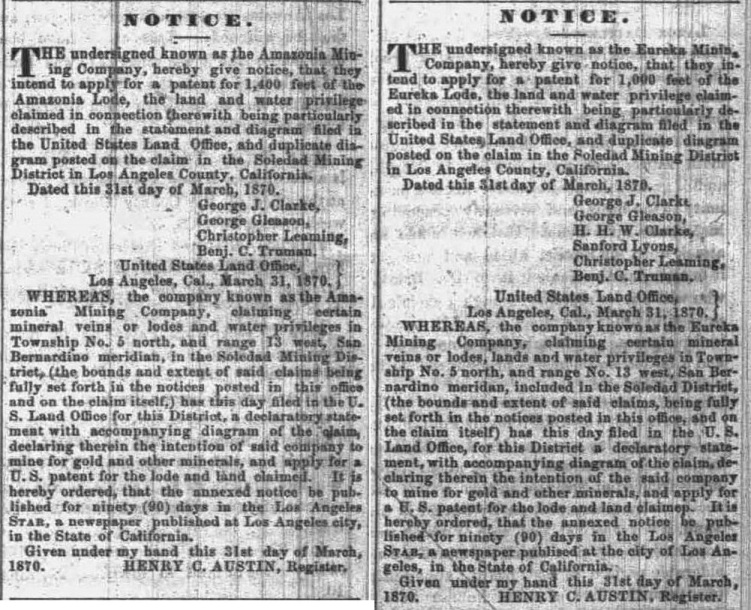
Leaming still had some interest in the copper mining near Ravenna, because in the Los Angeles Star of July 31, 1870, (and other newspaper issues) there was a notice that a patent would soon be applied for two of the companies he was involved with - the Amazonia and the Eureka Mining Companies. However, it appears that the patents were never received.
Dr. Vincent Gelcich bought the Leaming claim in 1872 and the Leaming Petroleum Company was formed to develop it. Gelcich received a half-interest in the company for deeding the claim to a group of five incorporators. However, little, if any, work was actually done on the claim.
Leaming had interests in other oil claims. Articles of incorporation were filed for the Lesina Oil Company. Capital was $100,000 in shares of $10 each. The directors were V. Gelcich, M.W. Childs, C.N. Wilson, Chris Leaming, Sanford Lyon, W.P. Smith, and B. L. Peel (Sacramento daily Union July 24, 1874). On July 25, 1874, the Los Angeles Herald reported that "the flow of oil on the Moore is quite large. It is the property of Messrs. M. W. Childs, Sanford Lyon and C. Leaming." Leaming also had a small share, with Sanford Lyon, in the Baker and Beale claim at Pico springs in 1876. In 1878, Leaming and Lyon conveyed any ownership they had on that Pico oil claim to F. B. Taylor (Los Angeles Herald April 25, 1878).
In the General Election held on November 7, 1882, the polling place would be the Southern Hotel in Newhall with Joel H. Turner inspector. J. W. Saunders and Christopher Leaming would be judges (Los Angeles Times October 31, 1882).
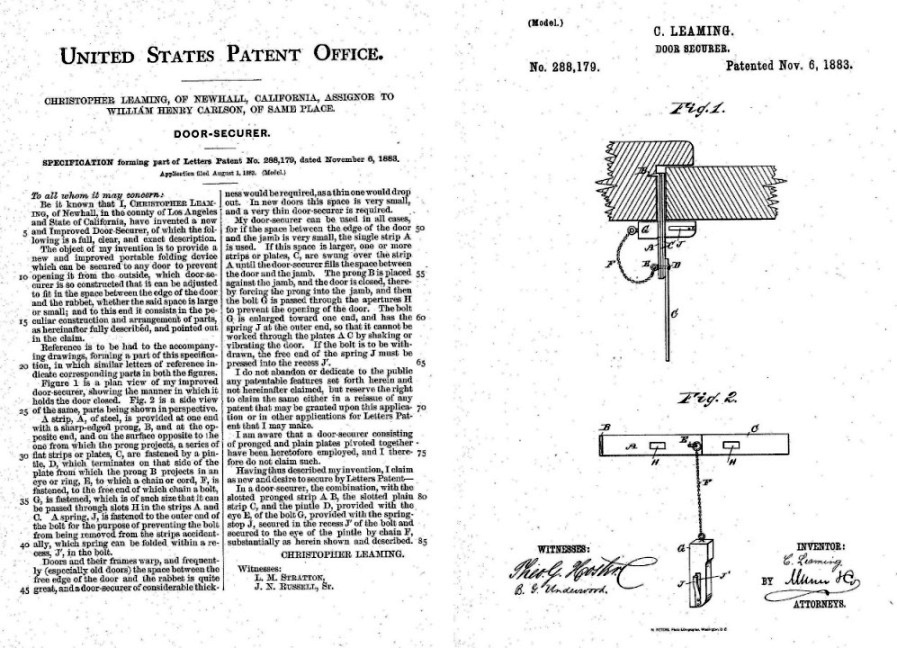
On November 6, 1883, Leaming was issued a patent (#288,179) for a "door-securer." (Sacramento Daily Union, November 7, 1883)
In 1884, Leaming was a Newhall delete to the county republican convention (Los Angeles Herald September 25, 1884). Again, Leaming (along with John F. Powell) was a Newhall delete to the county republican convention in 1886 (Los Angeles Herald July 27, 1886). In 1888, Leaming was a county delegate from Newhall to the Republican County Convention (Los Angeles Herald April 23, 1888).
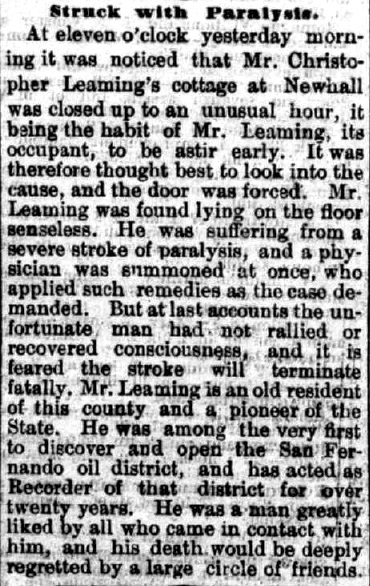
On April 28, 1888, Leaming was found lying on the floor of his Newhall home after evidently suffering a stroke (Los Angeles Herald, April 29, 1888).
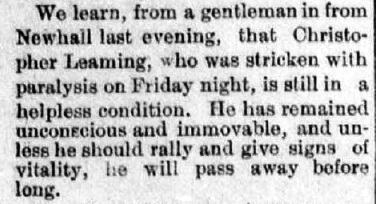
On May 1, Leaming was alive but still helpless (Los Angeles Herald, May 1, 1888).
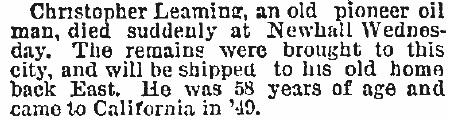
Christopher Leaming finally dies (Los Angeles Times, May 11, 1888).
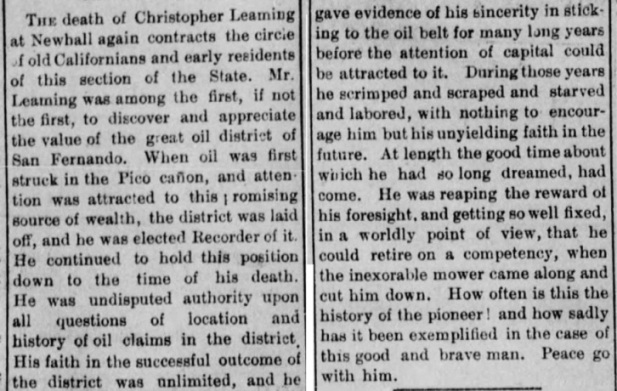
Leaming eulogized (Los Angeles Herald, May 12, 1888).
Wells in Leaming Canyon
The following quote is from "Petroleum in Southern California", 1913, Paul W. Prutzman, California State Mining Bureau, Bulletin 63. This is the only document I have found that said there were wells in Leaming Canyon.
Two wells are known to have been located in this canyon, but both were shallow, and can hardly be considered as tests.
Dividend Oil Company. The well of this company was near the south line of section 10, and about 1/8 mile from the east line of this section. It was carried to a depth of about 700 feet, and had no signs of oil.
California Oil Company. This company, which also drilled on section 18, 3-15, has a 400-foot abandoned well south of the canyon, in the northeast quarter of section 14. As might be expected, no oil was encountered at this depth.
These wells appear, superficially at least, to be on a secondary fold, or fault, roughly parallel to the main Pico-Wiley fault. The possible productiveness of this fold remains to be proven.
Unfortunately, the descriptions of the wells place them north of Highway 5 (Gavin Canyon) outside of Leaming Canyon, so it is unlikely that any wells were drilled in the actual canyon. Also, while hiking in the canyon, I did not find any trails or roads past the crib dam, and found no evidence of oil seeps or any human activity. It was virtually impossible to hike deep enough in the canyon to find the axis of the Pico Anticline, where most of the oil wells in the other canyons were drilled in or close to. None of the old topographic maps I examined showed a road into Leaming Canyon. Therefore, it appears that no drilling activity ever took place in Leaming Canyon.
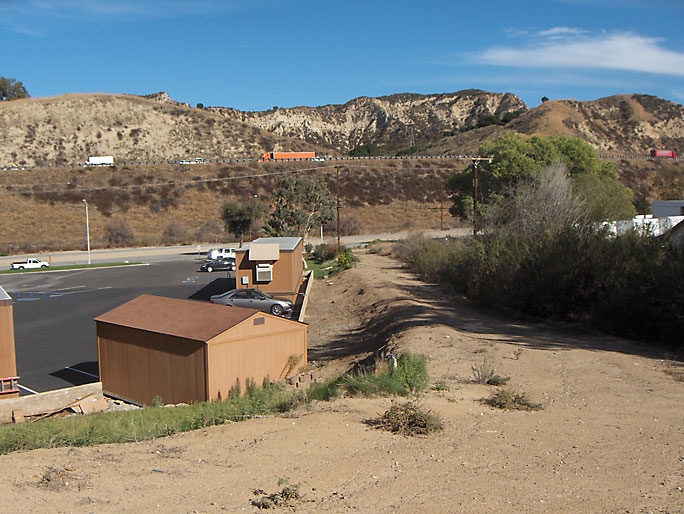
The road into Leaming Canyon to the crib dam. There is a church on the left and a private moving business on the right. This is a view toward the northeast. Leaming Canyon is behind me and The Old Road and the freeway are in front. (All photos were taken by me in November and December of 2008.)
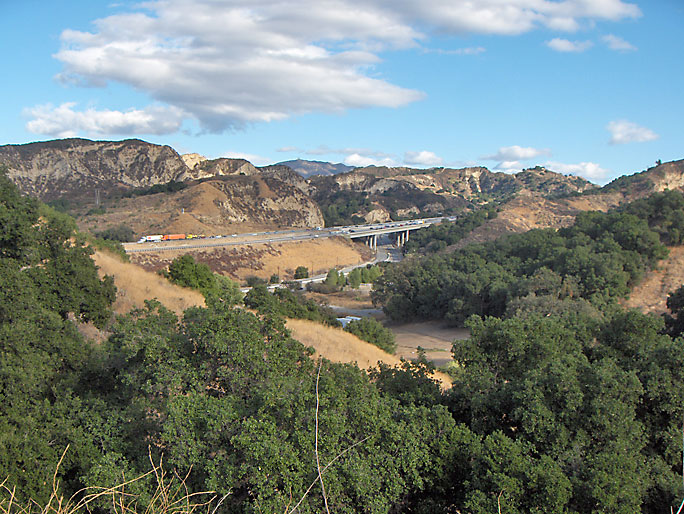
Another view of the canyon mouth area
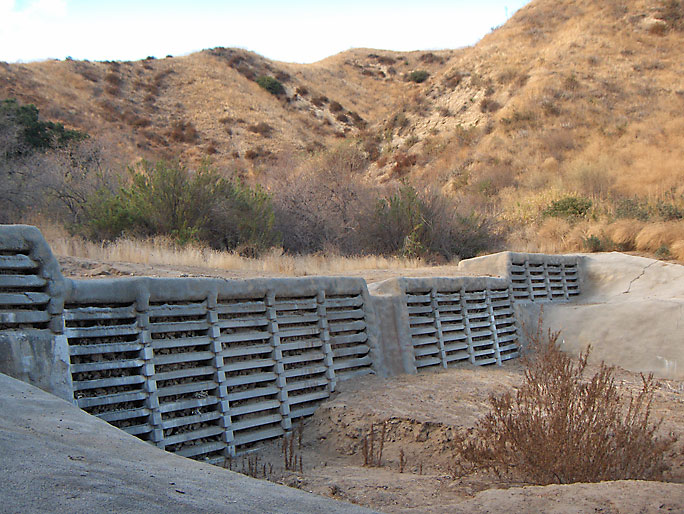
Crib dam
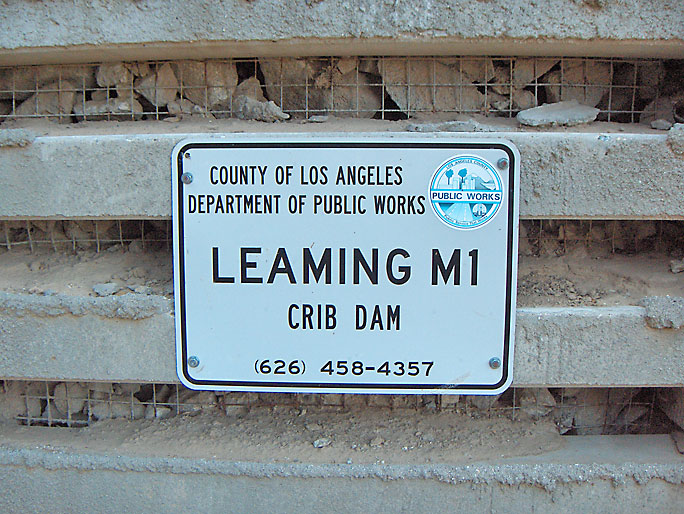
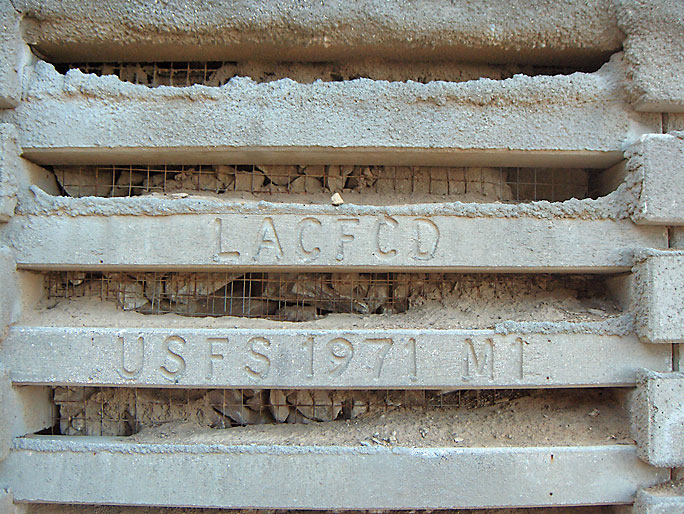
The crib dam was built in 1971
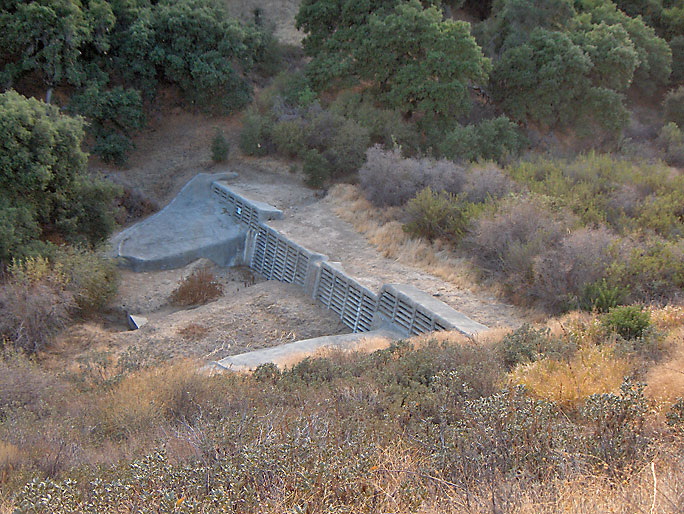
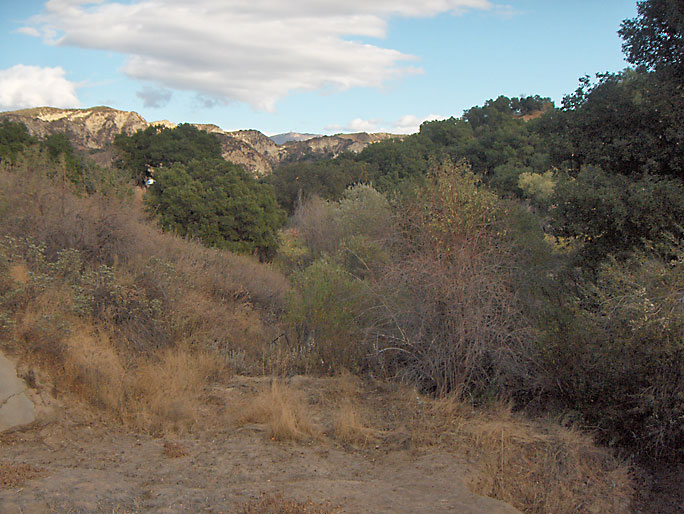
Looking northeast at the crib dam. Not too inviting - you have to go through all that brush just to get here.
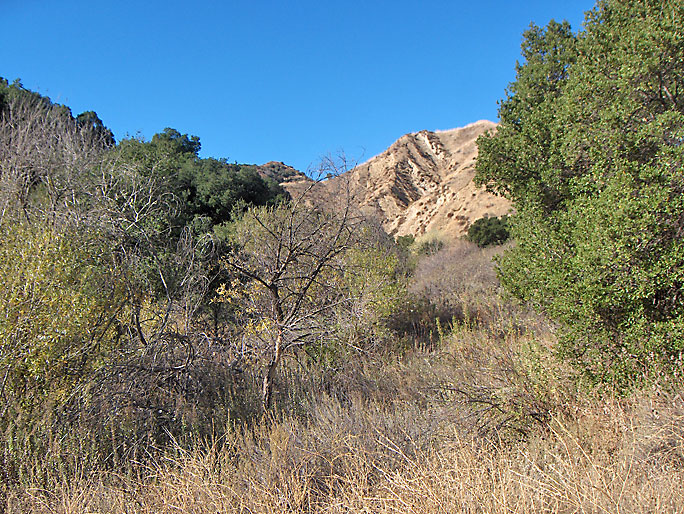
Looking southwest up Leaming Canyon. No roads or trails here.
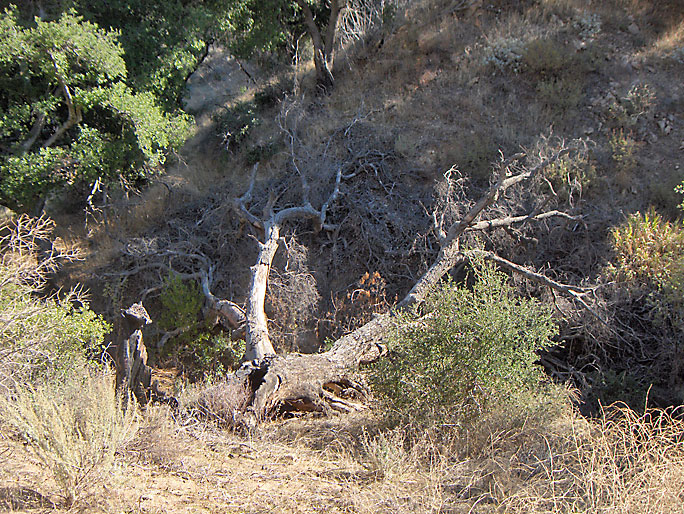
Tree blocking the creek bed
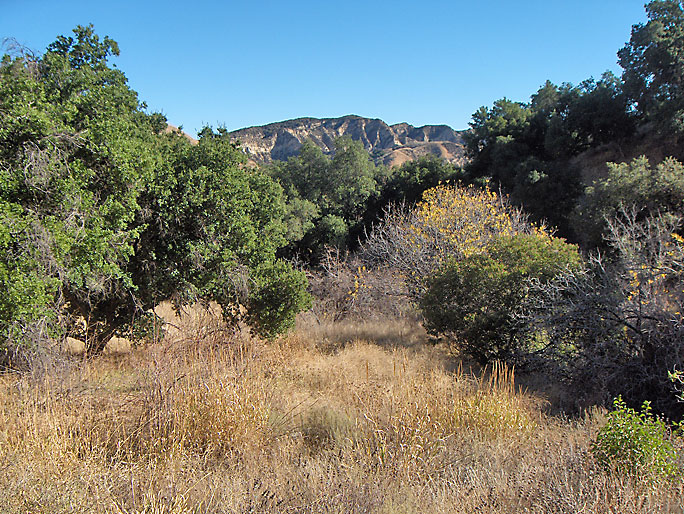
A little deeper in the canyon
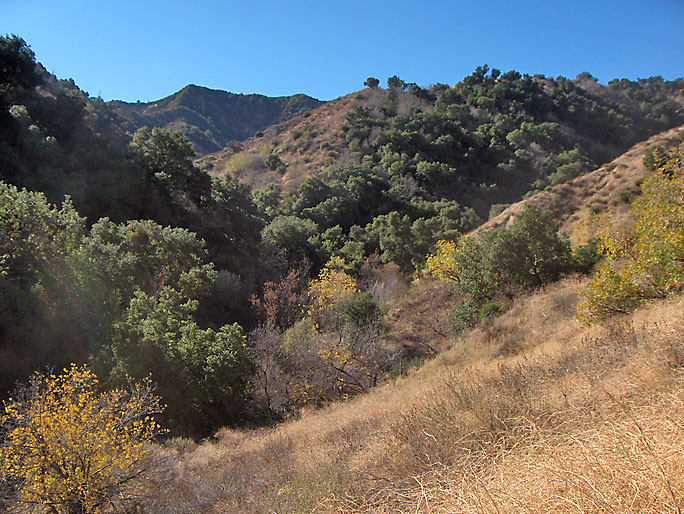
Still deeper in the canyon
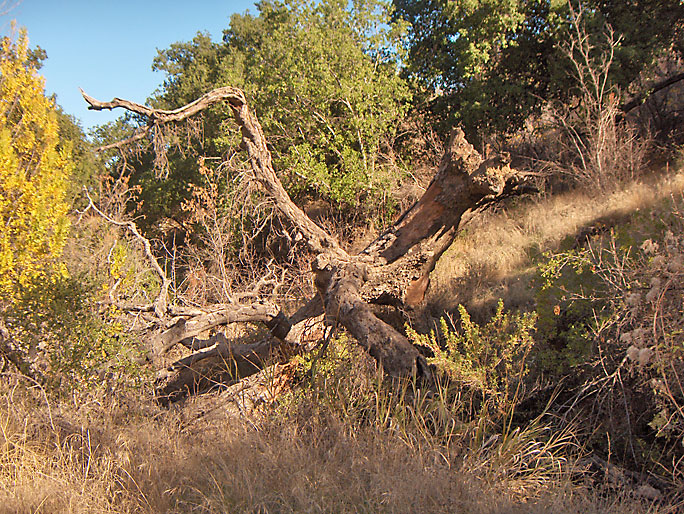
Another tree blocking the creek bed
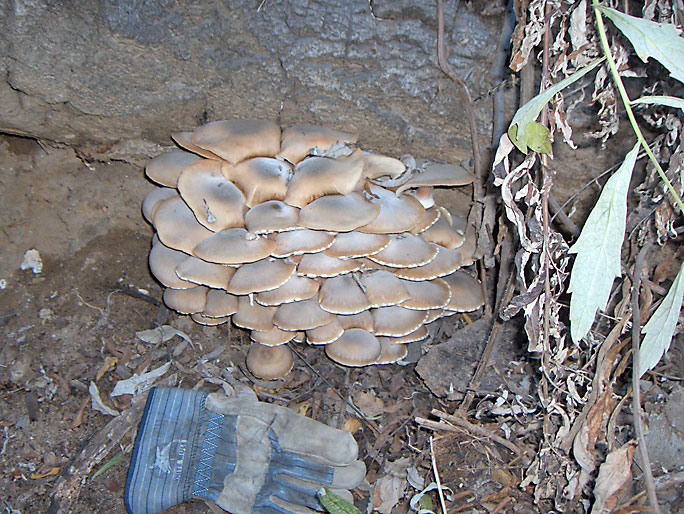
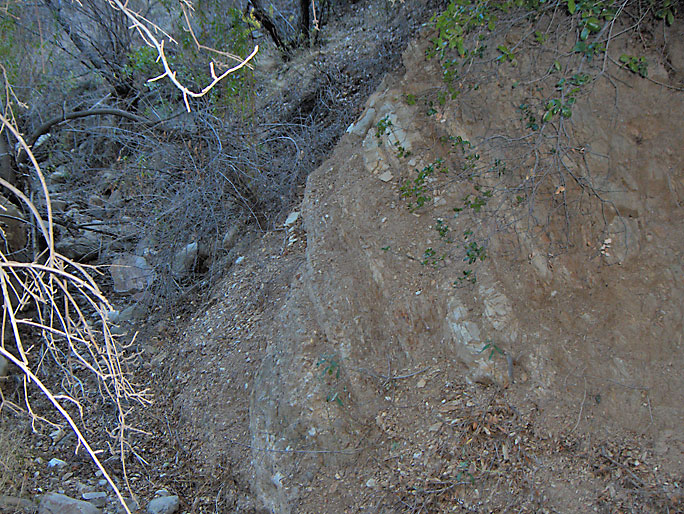
Exposure of the beds showing that I am in the north flank of the Pico Anticline
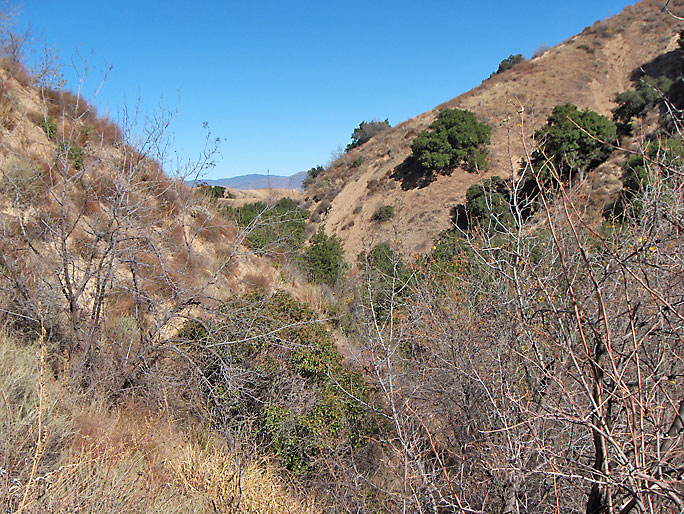
Looking back northeast down the canyon. Hiking is tough here. There are also a lot of ticks.
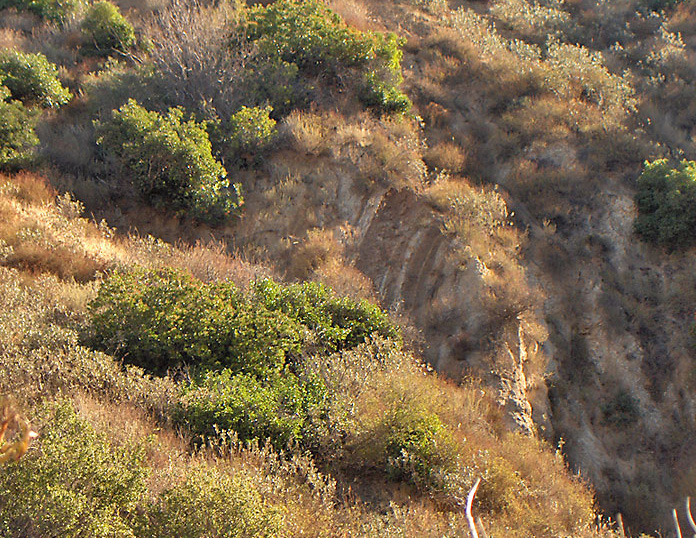
High above me is this exposure of the north flank of the anticline
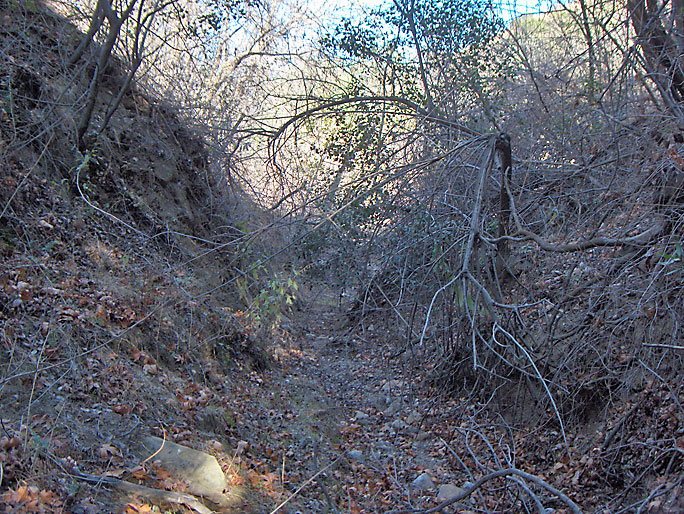
Hiking is very tough through here. Some of those leafless branches are poison oak.
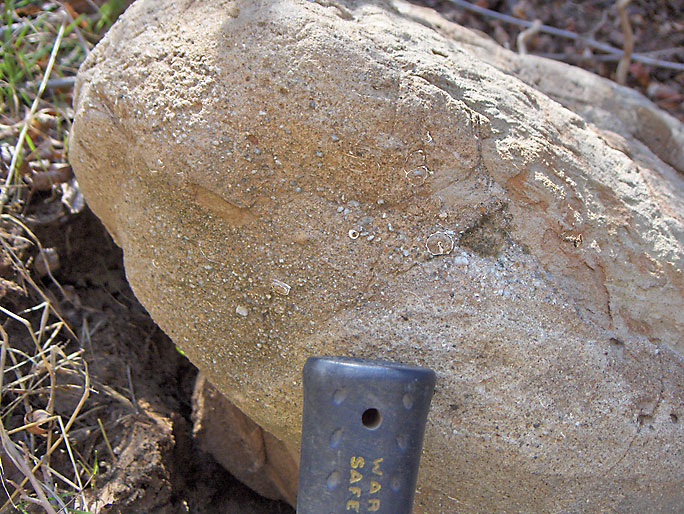
This is the most interesting object I found in the canyon - a bolder with fossils in it laying in the creek bed. The actual source of the bolder is probably in a bed high up above the canyon bottom and very hard to find. This is also unexpected because I found no fossils in Wiley or Rice Canyons, the canyons on each side of Leaming Canyon.
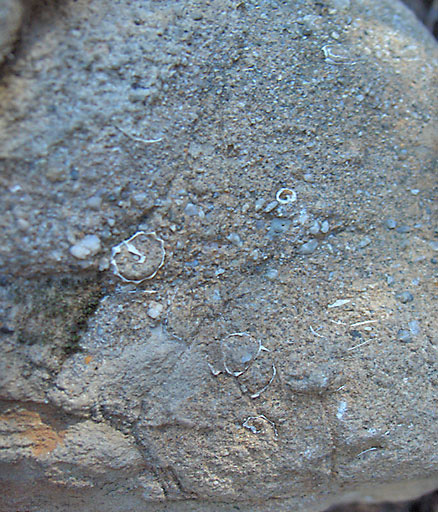
Close-up of the fossils. You can see cross sections of gastropods.
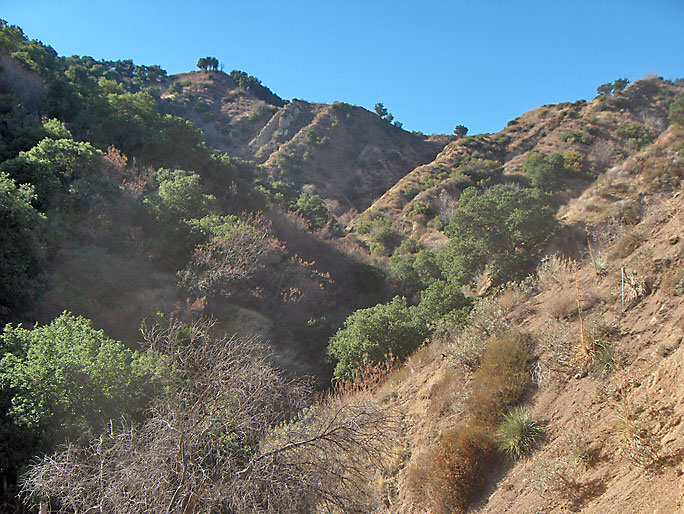
Looking up the western tributary of Leaming Canyon
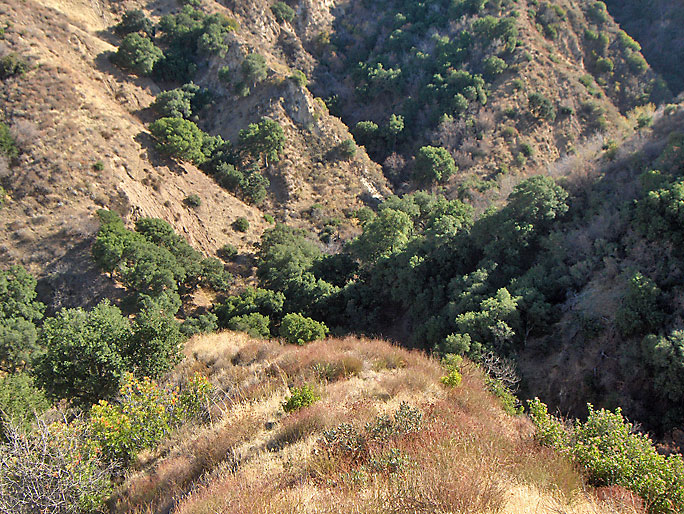
Looking down at the fork in Leaming Canyon. The tributary from the previous photo is coming diagonally toward the right bottom of the photo.