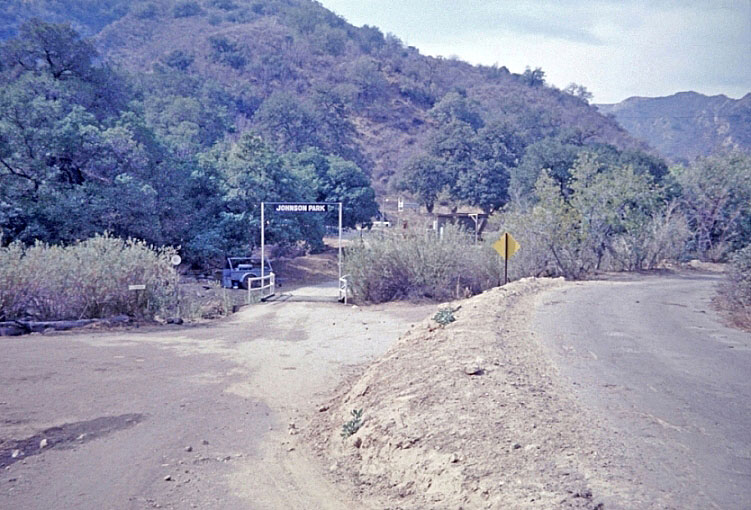
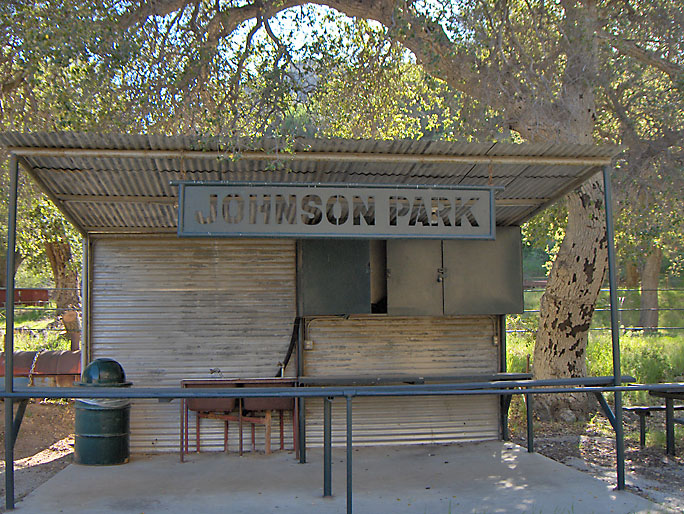
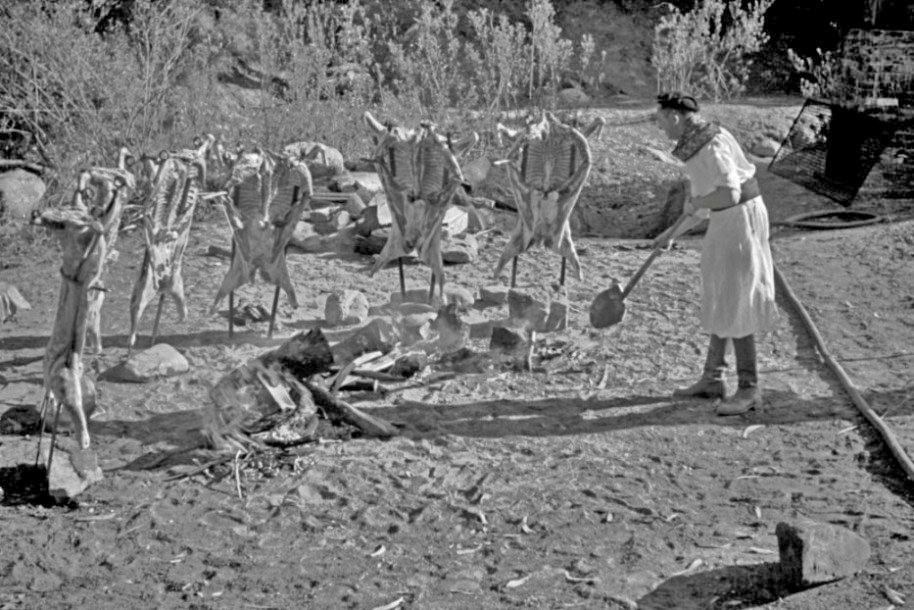
About 3/4 of a mile up from Mentryville is Johnson Park. Johnson Park was used by the oil workers living in the canyon for recreation and picnics. There are picnic tables, places to barbeque, a concrete dance floor, a bar, a horseshoe pit, and even a couple of craps tables. There was a picnic area in Pico Canyon even before there was a Johnson Park. The American Association of Petroleum Geologists (AAPG) had an annual picnic in Pico Canyon at, what was then called, the picnic grounds. I have found references to the AAPG annual picnics from the 1930's into the 1950's. There are photos from the 1939 picnic (see bottom of page).
Charles Sitzman was the Standard Oil superintendent in Pico Canyon from 1927-1937. His daughter, Barbara, who lived there at that time when she was a little girl, says that the picnic grounds were originally called "Grampa's Garden". The grampa was grampa Emmons, who had a garden there. George Emmons was born in 1882 and would have been 45 in 1927. He lived in Mentryville but could hardly be a grampa. Maybe his father lived there too, but I couldn't find him (the father) on the 1920 or the 1930 US Census.
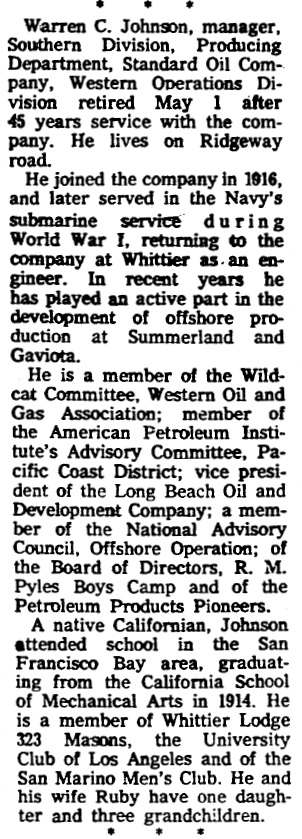
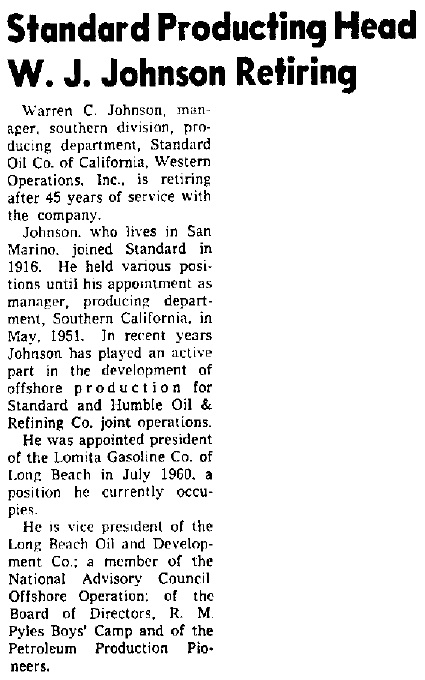
I have not found newspaper or Standard Oil references as to how Johnson Park got its name. In 1962 ("Pico Ghost Camp", Newhall Signal, 1/25/1962) , A.B. Perkins says it was called Johnson Park, but didn't know who Johnson was. Jerry Reynolds (Pico Canyon Chronicles, 1985) says it was named for a retired Division Manager for the Southern District of Chevron named Warren Johnson. Darryl Manzer also says it was named for former Operations Manager Warren Johnson. They must mean Warren Charles Johnson. He was born April 18, 1896 in San Francisco and became an employee of Standard Oil in 1916. On August 19, 1919, Johnson married Ruby Rees. They had one daughter. On June 6, 1953, Johnson was in Pico Canyon for the dedication of the monument and plaque for the Pico 4, the "First Commercial Oil Well in California". On May 1, 1961, Johnson retired from Standard. At that time he was the Manager, Southern Division, Producing Department, a title he had held for 10 years. On August 29, 1984, Johnson died in San Marino, California. Since Perkins' statement was in 1962, the park had to have been named by then, maybe in honor of Johnson's long service with the company.
However, there was also a Chester Johnson working for Standard and living in the canyon in the 1940's. Could the park been named for him?
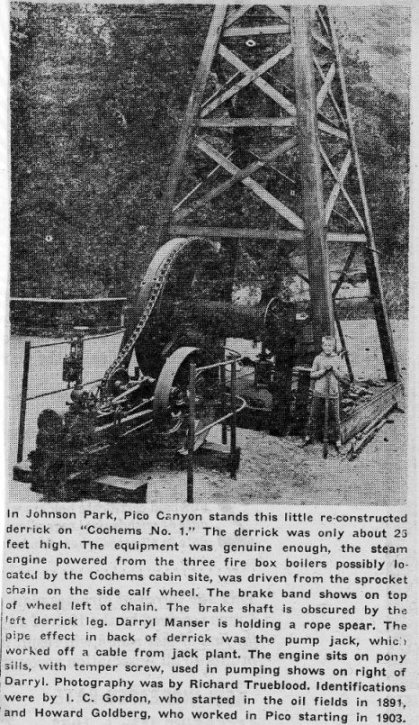
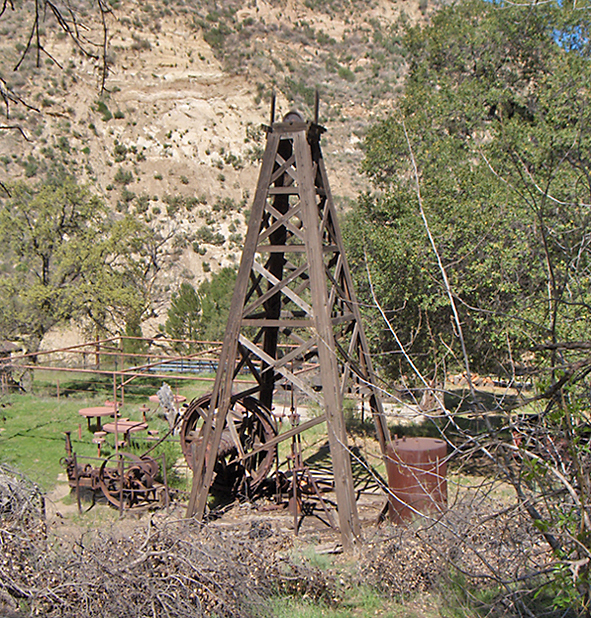
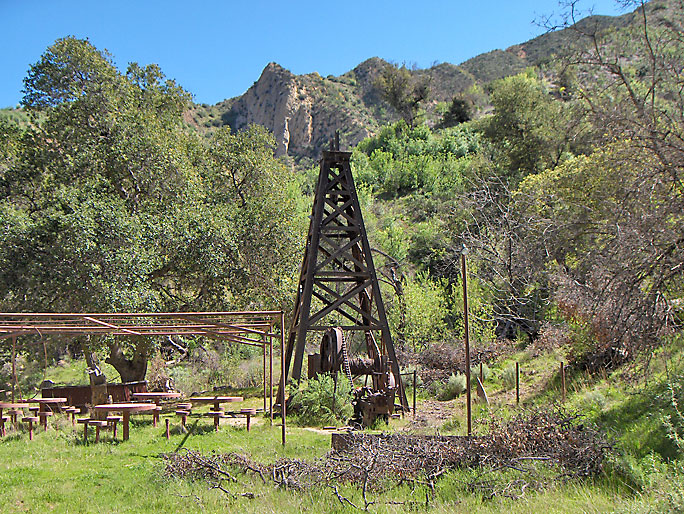
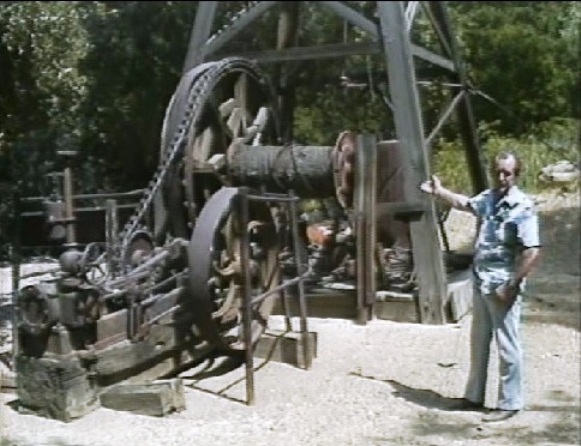
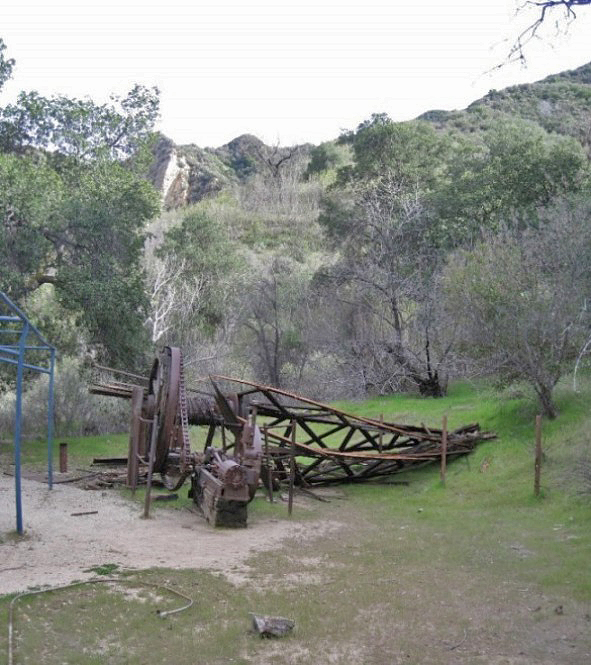
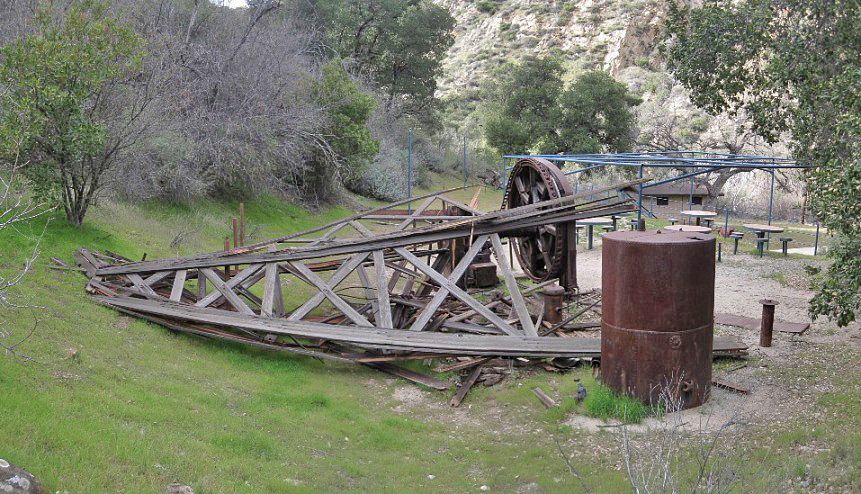
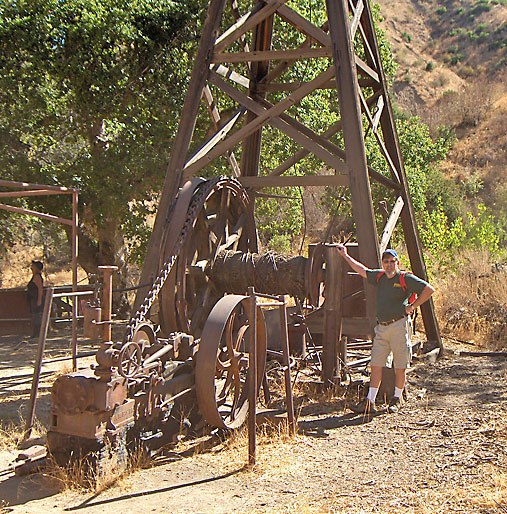
In the early 1960's Frenchy Lagasse, Alton Manzer (Darryl's dad) and others built a replica 25-foot derrick out of genuine equipment to mark the retirement of another oil worker, Bill Cochems. It would be called Cochems 1 in Bill's honor. Bill Cochems was the son of Anthony Cochems, the one-time baker in Pico Canyon. See part of an 1985 video showing the Frenchy and the derrick here (mp4). The derrick collapsed in early 2023.
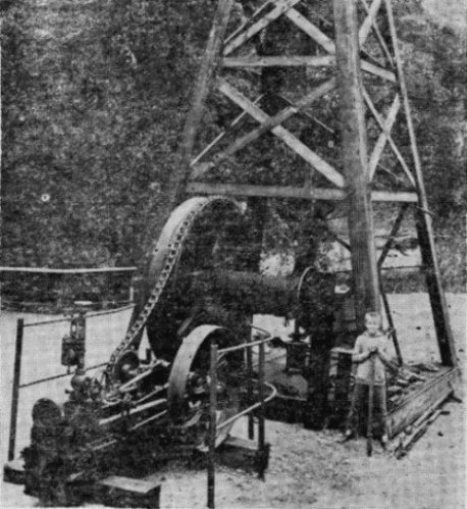
A picture of the replica derrick is shown in a Daily Signal article from 1962 - "Pico Ghost Camp" - by A.B. Perkins (part 2, 1/25/62).
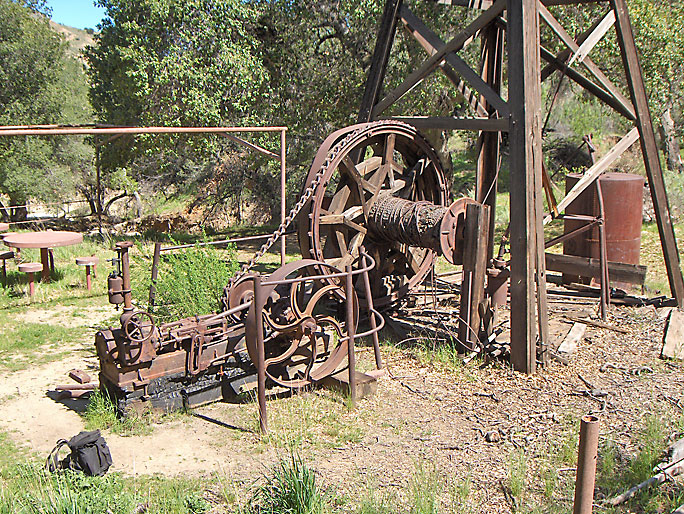
This engine never ran here - the rig was only for show.
Replica derrick with the white "Cochems No. 1" sign in the late 1960's. Sometime in the future this sign will be removed.
Copyright Note: This image is NOT in the public domain and was used by permission of the Santa Clarita Valley Historical Society, Barbara Sitzman Cook Collection.
Closeup of "Cochems No. 1" sign.
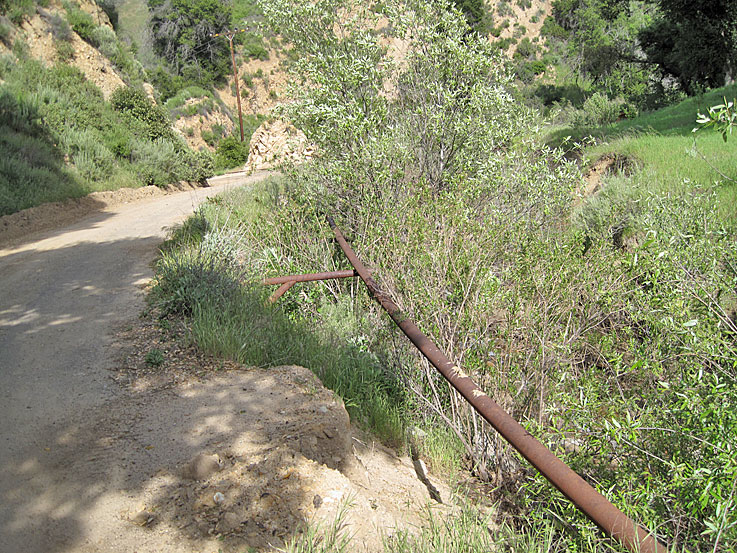
Just before you get to Johnson Park is this old water pipe that is still being used to get water to the new silver tank further up the canyon. It was never used for oil. (4/11/2011)
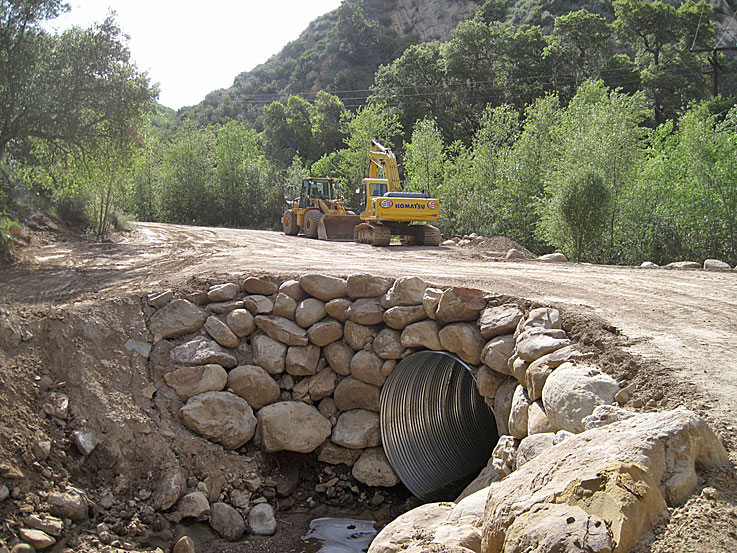
A new pipe bridge was been built in 2011 providing another road into Johnson Park. (4/11/2011)
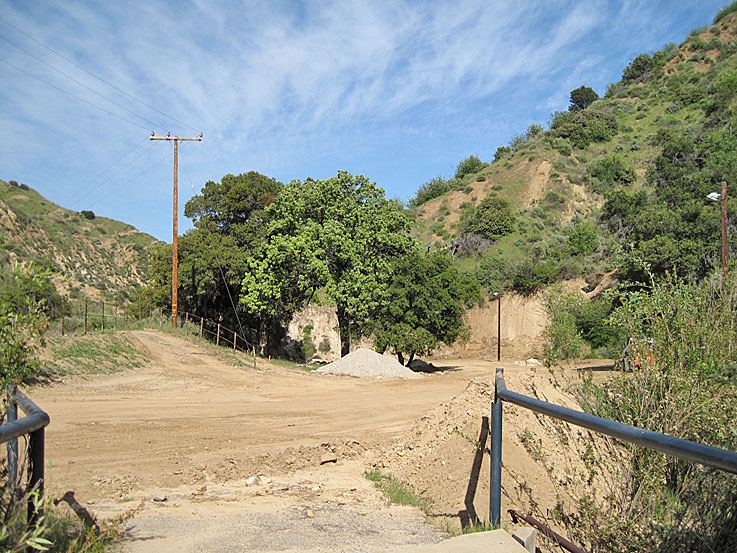
The new road (4/11/2011)
Entrance to Johnson Park in the 1960's. The sign over the little bridge is gone and was replaced by a new sign in the picnic area.
Copyright Note: This image is NOT in the public domain and was used by permission of the Santa Clarita Valley Historical Society, Barbara Sitzman Cook Collection.
Now we are in Johnson Park looking at the new sign. (3/14/2008)
Replica derrick in 2008. (3/14/2008)
Another view of derrick. (3/14/2008)
The little kid standing in front of the derrick in the 1962 Signal article (see above) was Darryl Manzer
Here he is on 10/16/2008 when he gave a group of people, including me, a tour of the canyon, his home for 6 years in the 1960's.
Frenchy Lagasse standing in from of the replica derrick in an 1985 DOGGR video. See this part here (mp4).
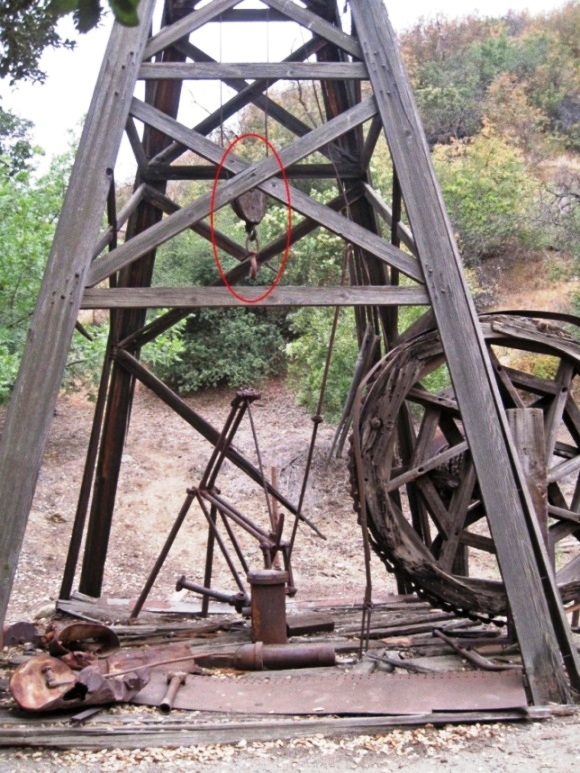
Snatch block (3/14/2008)
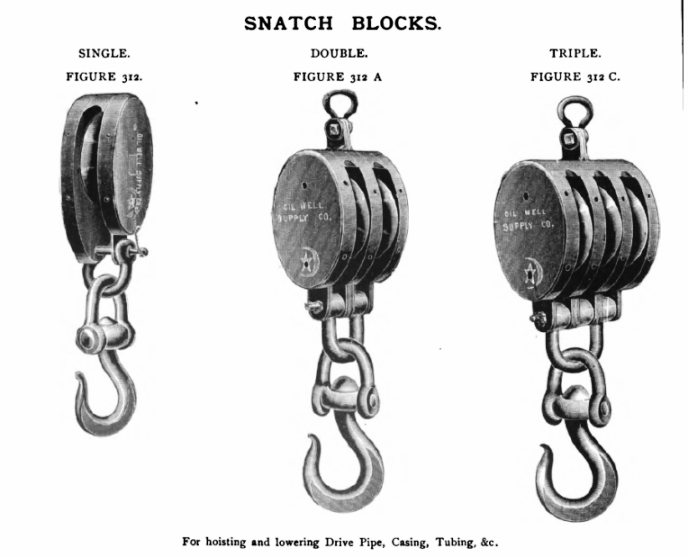
Snatch blocks from the Illustrated Catalogue of the Oil Well Supply Co., Pittsburgh, Pa, 1892, p. 122
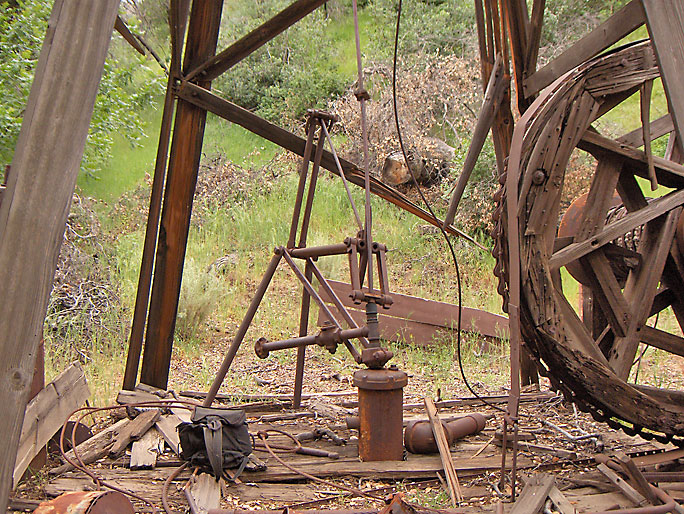
Pump jack. It would be attached to a jackline which was controlled by a central power unit at the jack plant. (3/14/2008)
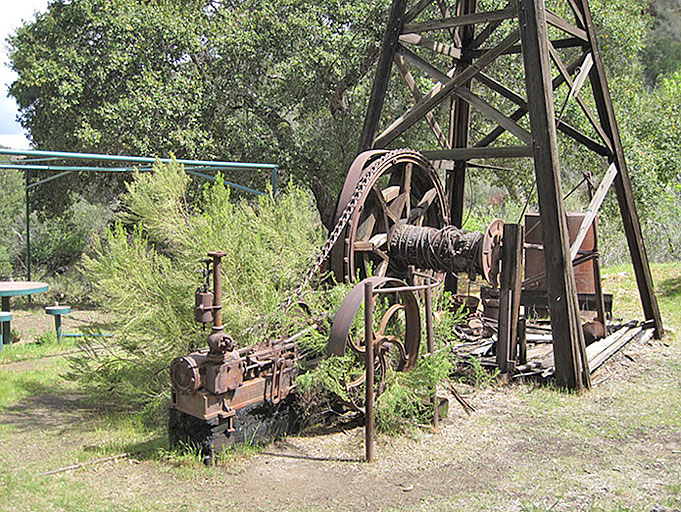
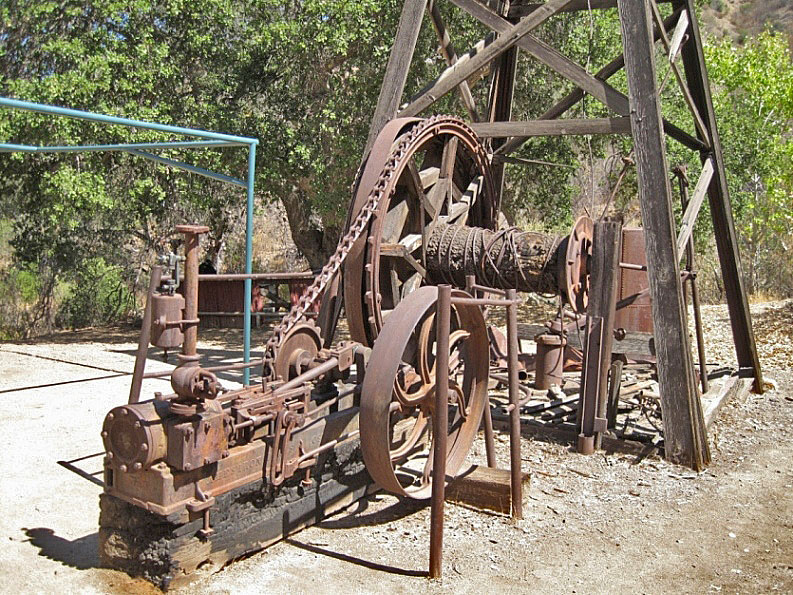
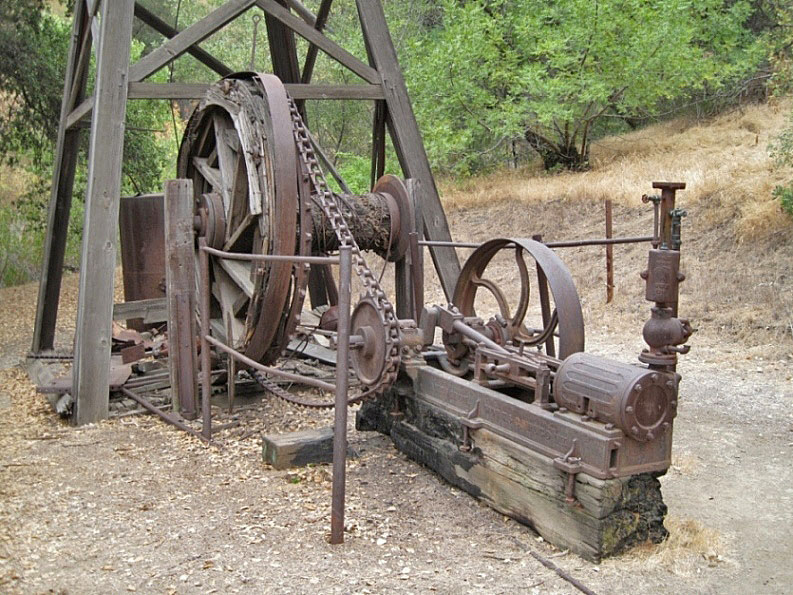
View of engine with calf wheel in the background. The engine marking says "Ames' Iron Works - Oswego N.Y. - NO. 5". In this setup, the engine would be used to raise or lower casing. It could not drill or pump because there is no walking beam here. (3/14/2008)
View of engine on 3/18/2012. Why was this bush allowed to grow around it?
View of engine on 9/17/2014. Bush removed by me 6/2013.
Another view (7/10/2013)
Ames' Iron Works (3/14/2008)
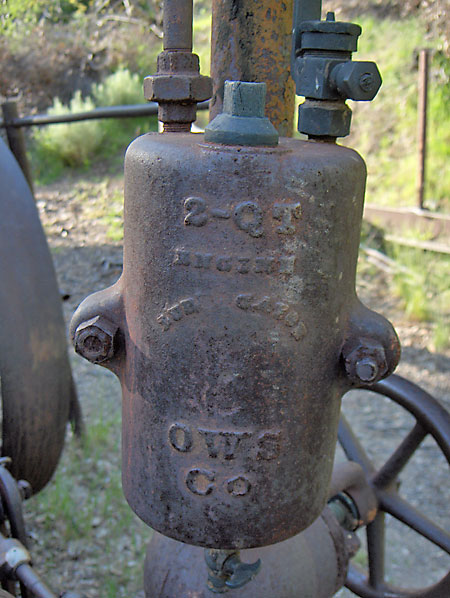
This is an engine lubricator. It contained oil to lubricate the moving parts of the engine. (3/14/2008)
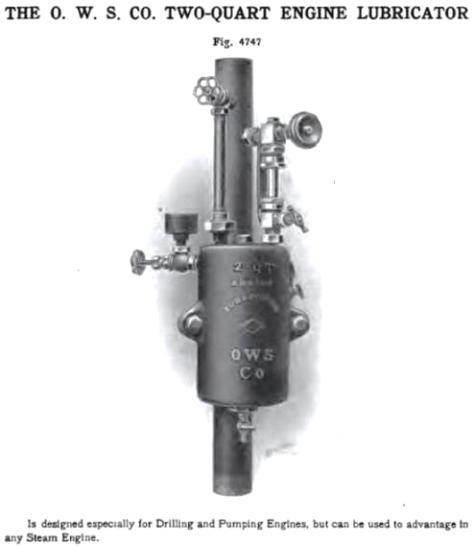
From the Oil Well Supply catalog of 1907. The one in Johnson Park is a single.
Closer view of brake band around the calf wheel. The brake band staple (which would be bolted to the derrick floor by two bolts) is in the left part of the photo and the brake lever is in the right part (also bolted to the floor). The almost 6-foot long lever would be pulled to shorten the circumference of the brake band, braking the wheel. (3/14/2008)
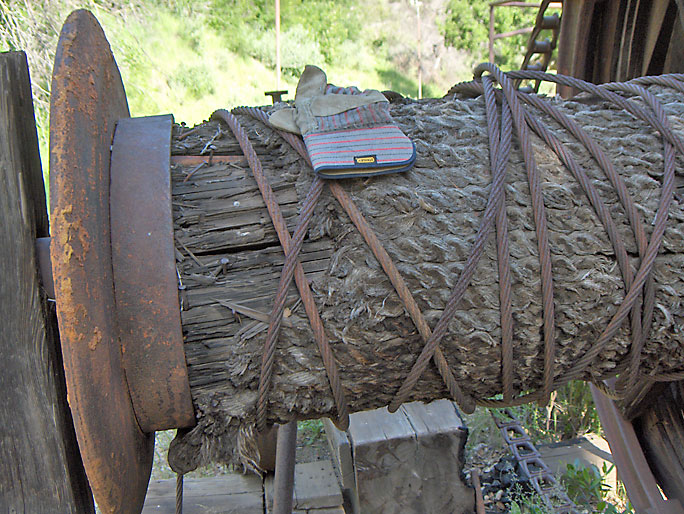
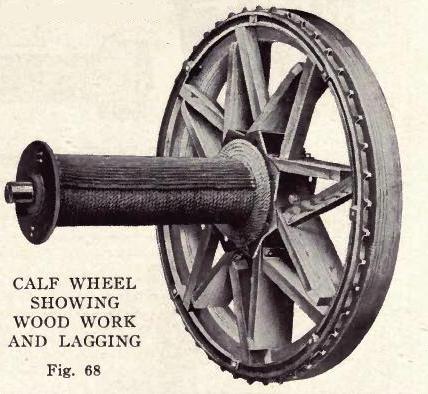
Closer view of calf wheel shaft. The shaft is made of wood. There is an iron gudgeon at each end of the shaft. There is also a thick material covering the wood called lagging. (3/14/2008)
Calf wheel shaft from the 1914 Fairbanks Morse Oil Well Supply Catalog
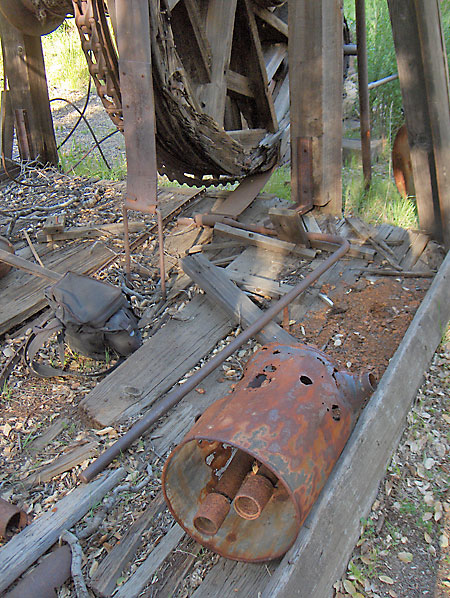
This looks like a cutter for an under reamer cable tool bit. There would be two cutters on the bit. (By 2014 this artifact is gone) (3/14/2008)
Unknown object. By 2014 this artifact is missing. (3/14/2008)
(4/19/2008)
Replica derrick on 10/16/2021. Looks like it's about ready to fall down.
After over a year from the previous photo, the derrick finally collapsed. (2/18/2023)
Opposite view. Many months after the collapse, the MRCA has not removed the remains. (2/18/2023)
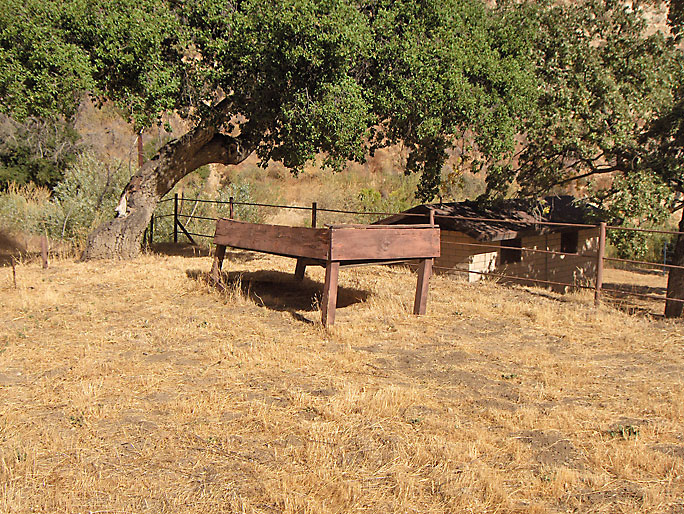
Craps table near horseshoe pit (By 2014 this table gone) (4/19/2008)
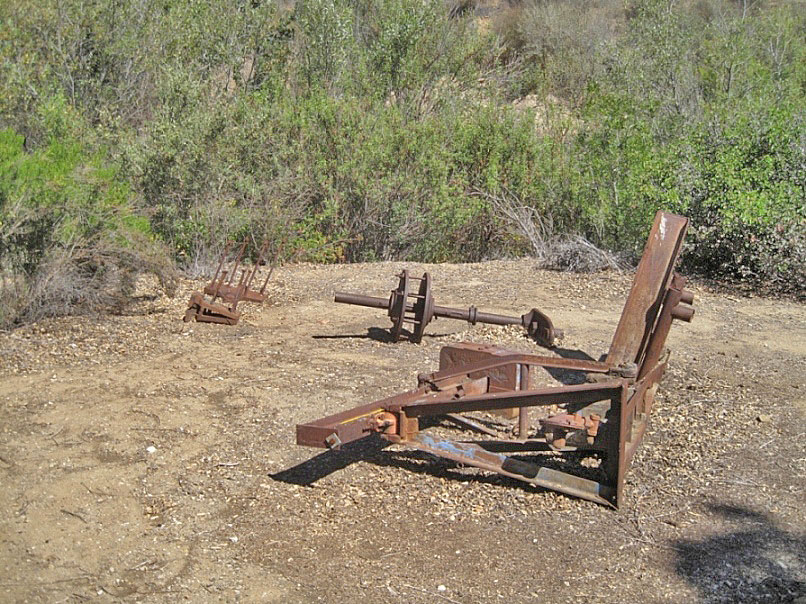
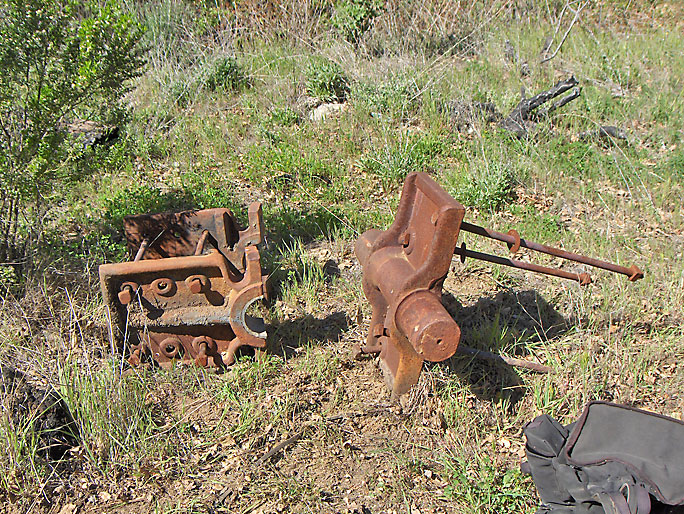
On the far side of the bathroom are these artifacts (7/7/2015)
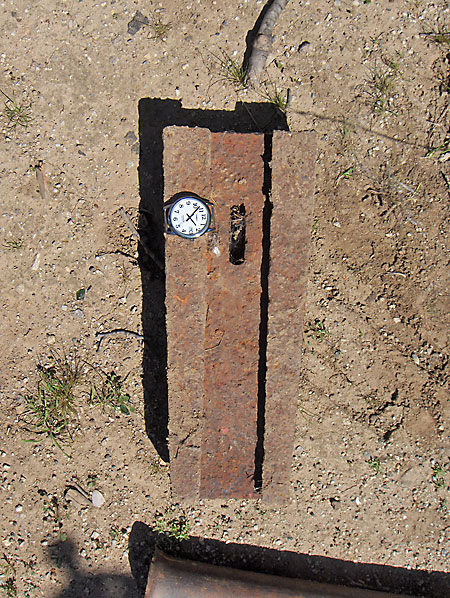
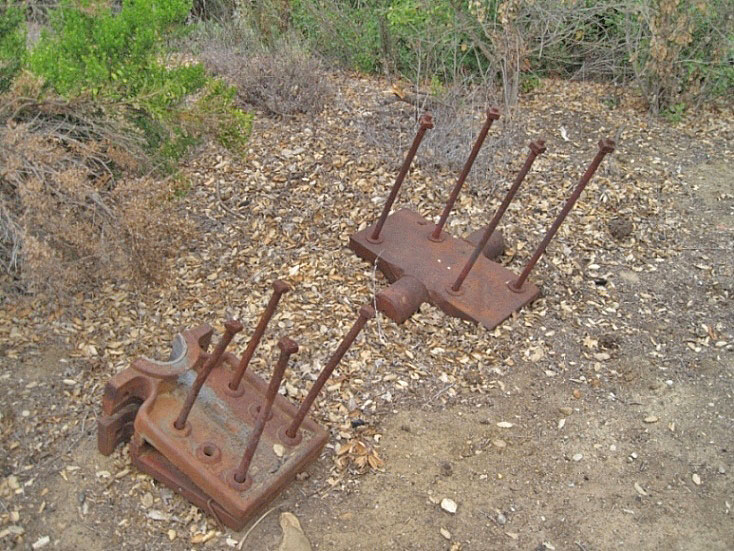
Center irons. They supported and provided the pivet point for the walking beam. (3/14/2008)
Center irons on 7/7/2015
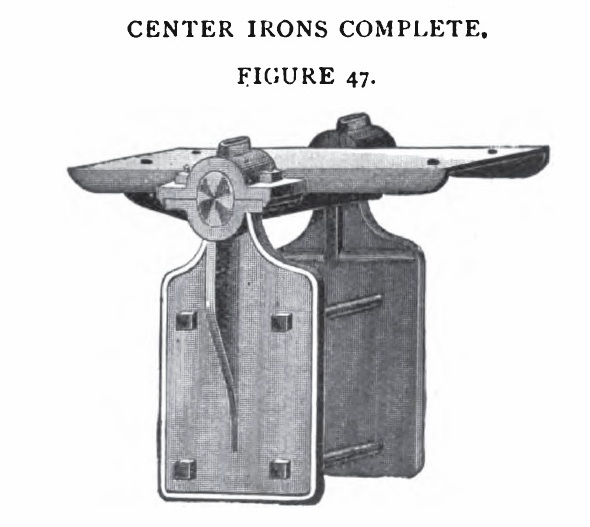
Diagram of center irons from the Illustrated Catalogue of the Oil Well Supply Co. of 1892. The walking beam would be bolted on the top part.
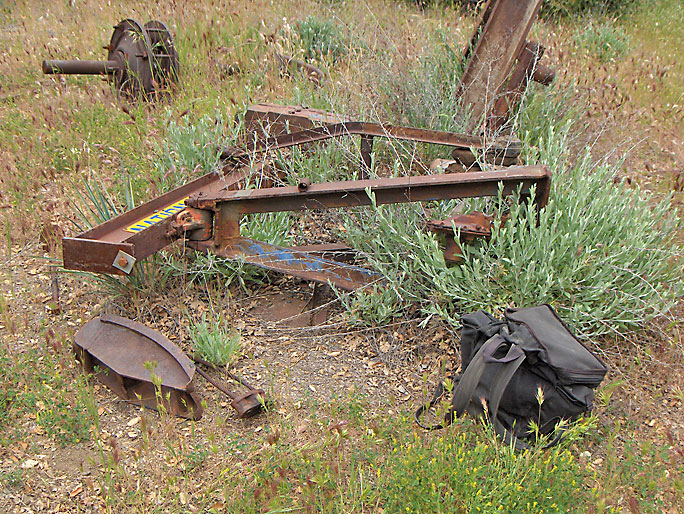
Walking beam stirrup. The wide part on top was placed on one of the ends of the walking beam. The narrow part with the three bolts was attached to a wooden arm called the pitman. the pitman was attached to a crank shaft for a band wheel. The band wheel was powered by a steam engine and, as it rotated, the pitman moved up and down causing the walking beam to go up and down. The other end of the walking beam was attached to the drilling cable. Sometime in 2014 this stirrup disappeared. (3/14/2008)
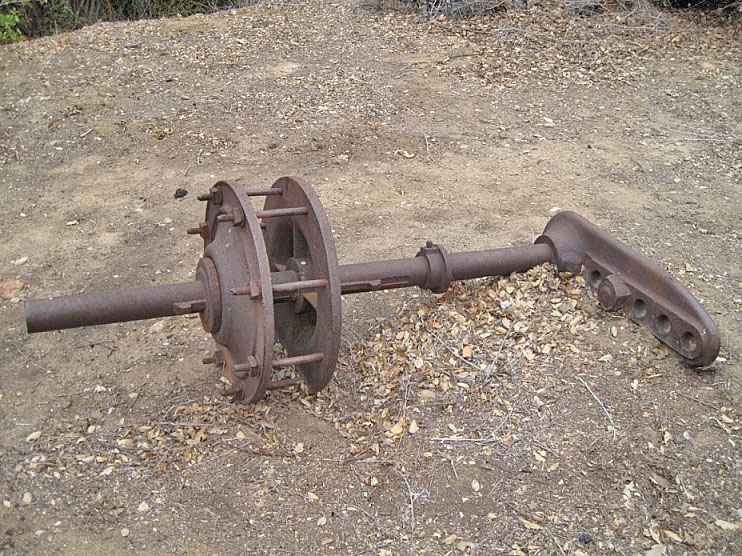
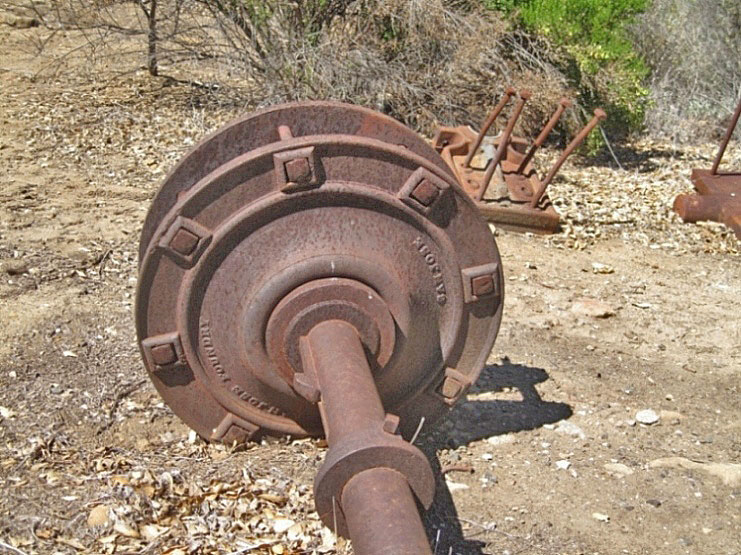
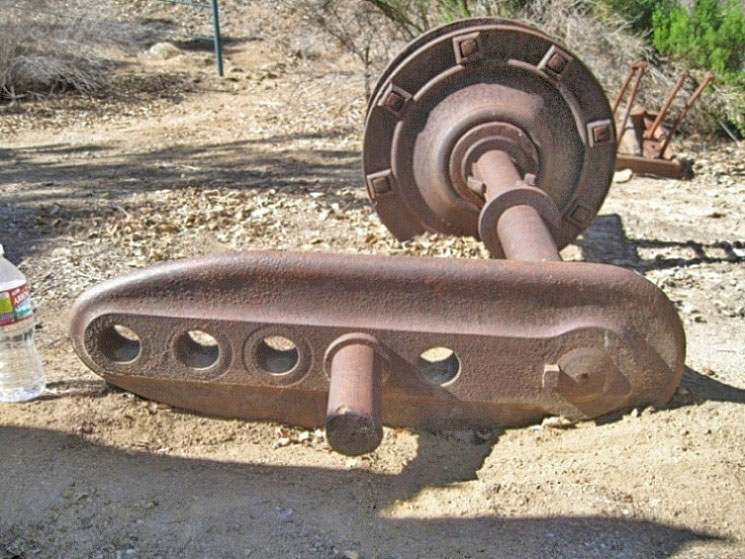
Band wheel shaft, flanges (the two wheels bolted together), and crank at the end. The band wheel (missing here) would be between the flanges. The band wheel would be connected to the engine with a belt. The pitman attaches to the crank. (7/7/2015)
The flange says "San Jose Foundry" and "San Jose". The San Jose Foundry was established in 1852. (7/7/2015)
Closer view of crank showing five holes for the wrist pin (currently in the second hole from the right). The wrist pin attachs to the pitman. The hole used for the wrist pin would control the distance the walking beam travelled up and down. As the pin was moved closer toward the shaft, the up and down distance would decrease. (7/7/2015)
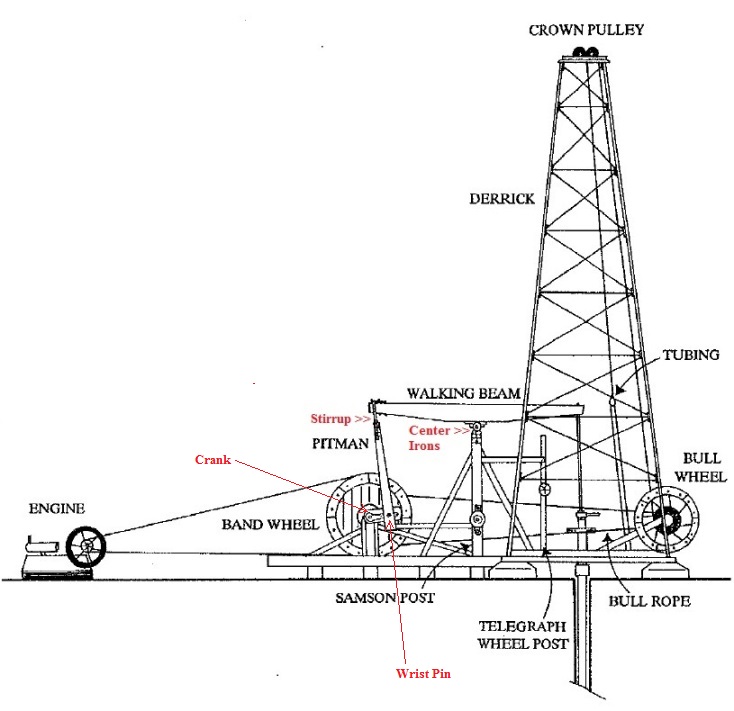
Simple oil rig diagram showing location of band wheel, stirrup, center irons, crank, and wrist pin
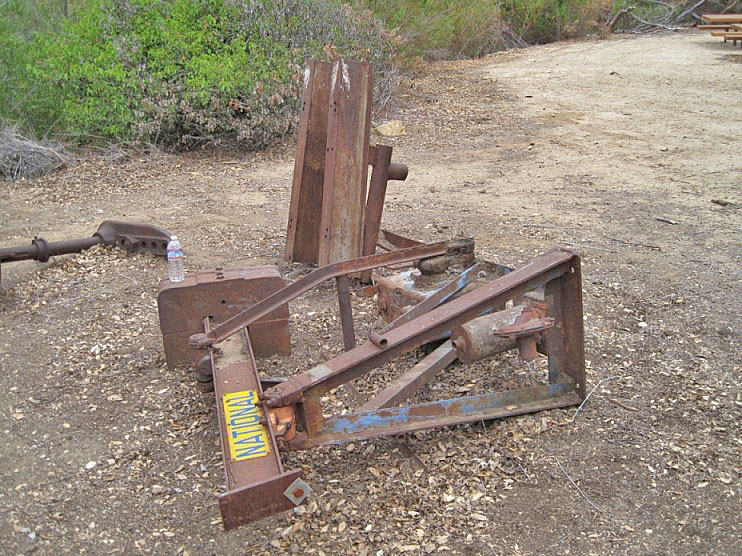
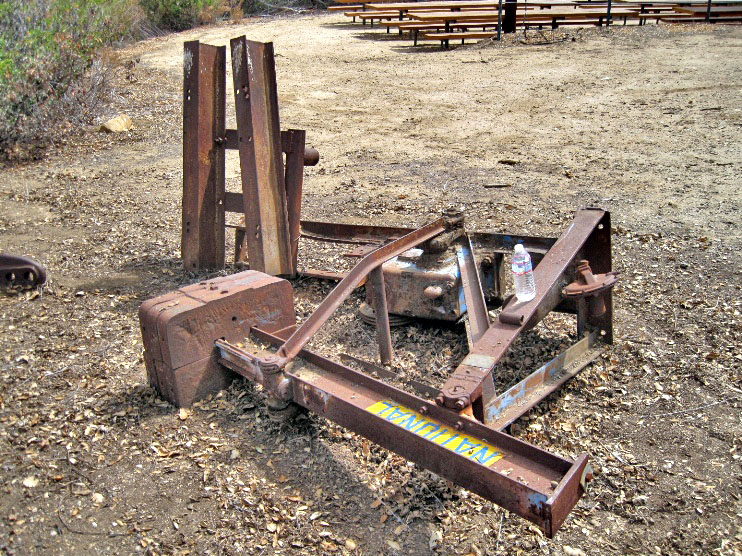
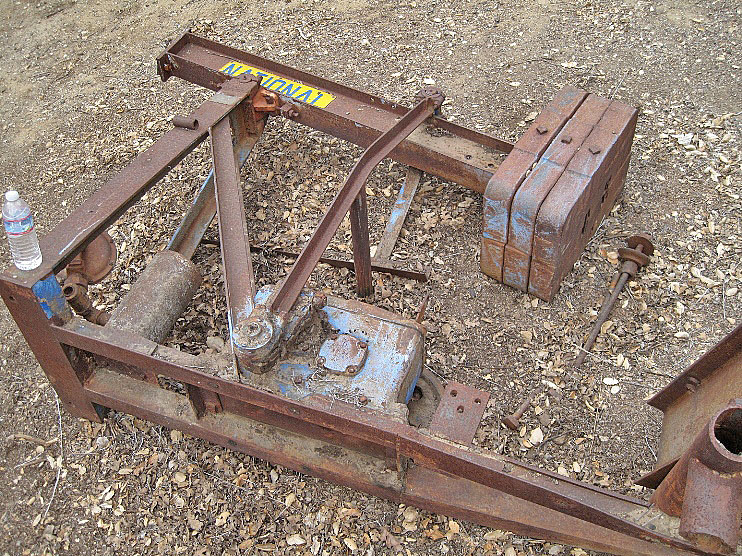
National pump. This is not the last pump used on CSO 4. That pump was not a National. Note what is sometimes called a horsehead in the lower right of the photo. Like the above stirrup, the horsehead disappeared since this photo was taken on 4/19/2008.
Photo taken on 7/7/2015
Photo taken on 7/7/2015
The yellow "National" is on the walking beam. The heavy looking objects on the right end of the walking beam are counterweights. Photo taken on 7/7/2015
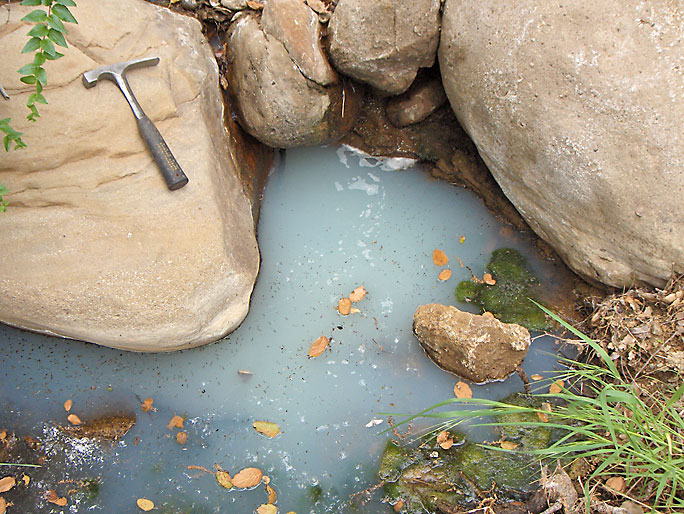
This water is flowing down the canyon next to Johnson Park (Hughes Canyon) into Pico Canyon. The white stuff is not milk. There is a smell of sulfur in the air. (4/19/2008)
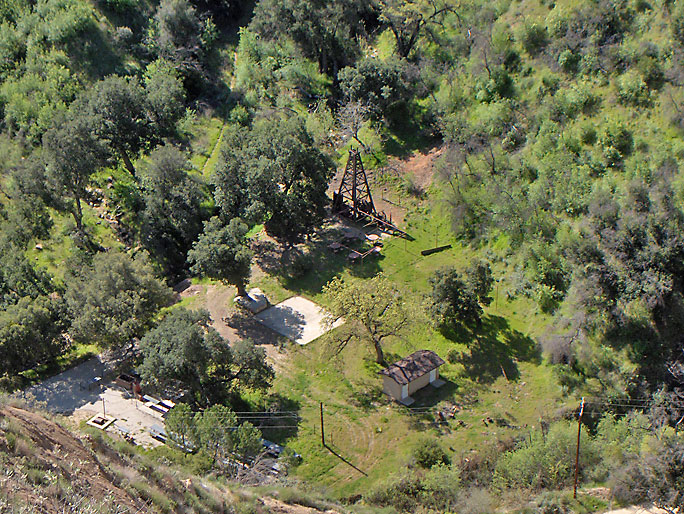
From high above on the ridge looking down (to the south) at the park. (3/28/2009)
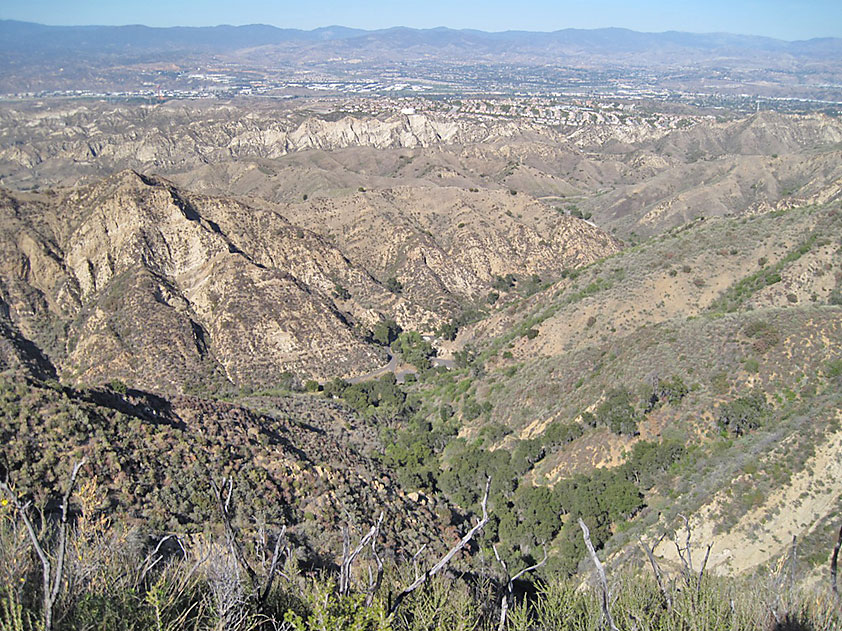
Looking north down Hughes Canyon to the park way down below. (3/21/2012)
San Marino Tribune of May 11, 1961
Long Beach Independent Press Telegram of April 30, 1961
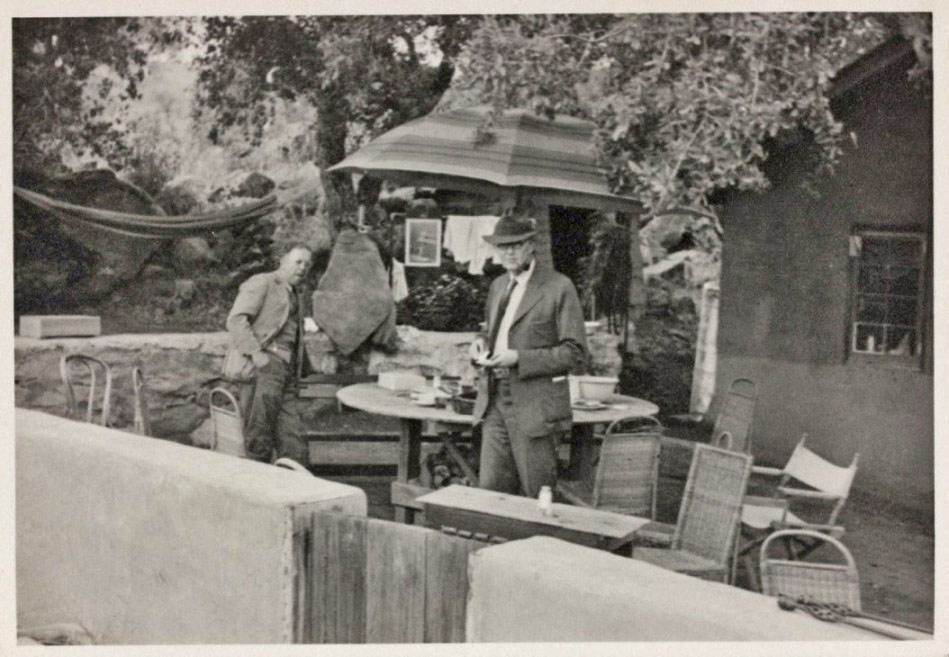
For many years The American Association of Petroleum Geologists (AAPG) had an annual picnic in Pico Canyon at, what was then called, the picnic grounds. Here is a photo from the 1939 picnic.
Used by permission from the Robert B. and William R. Moran papers. Mss 282, Department of Special Collections, University Libraries, University of California, Santa Barbara.
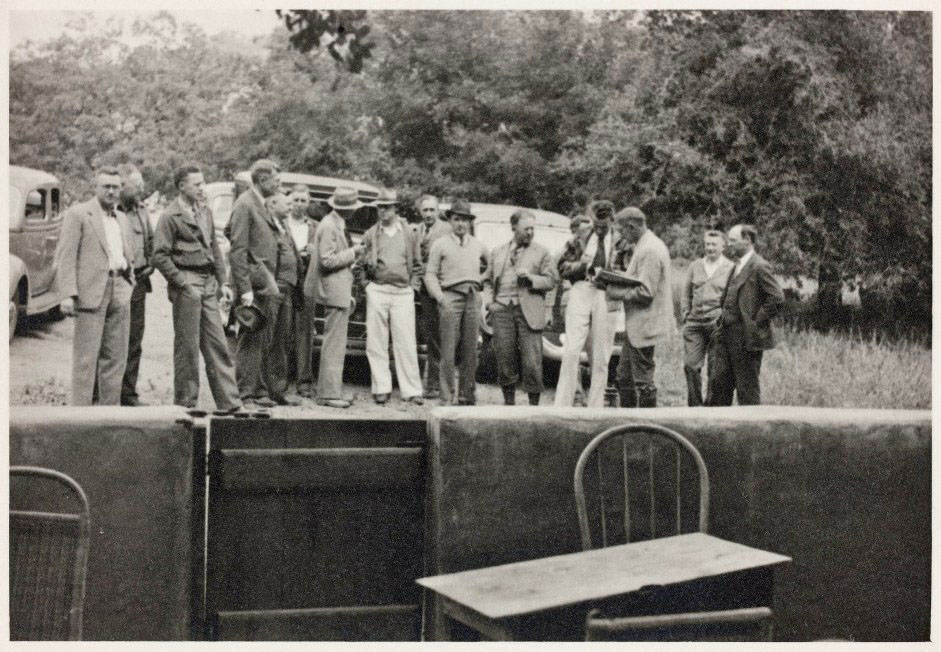
Another photo from the 1939 picnic.
Used by permission from the Robert B. and William R. Moran papers. Mss 282, Department of Special Collections, University Libraries, University of California, Santa Barbara.
Still another photo from the 1939 picnic.
Used by permission from the Robert B. and William R. Moran papers. Mss 282, Department of Special Collections, University Libraries, University of California, Santa Barbara.