The Tragic Life of Margaret Lang
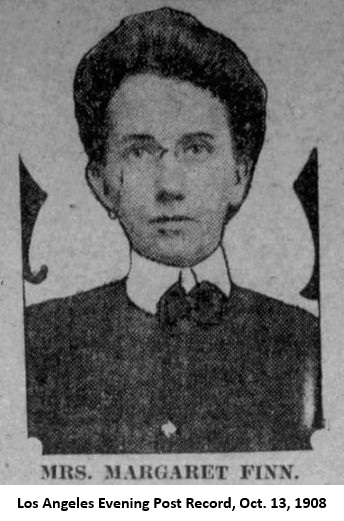
Margaret ("Maggie") M. Lang was born on May 3, 1873, at Lang's Station in Soledad Canyon, Los Angeles County, California.[1] She was John and Mary Lang's sixth, and final, child.
Nothing is known of Maggie's childhood. However, in 1908, her brothers William and James stated that her mother had suffered severe pain from a tumor and an operation to remove it just before Maggie was born. They believed that this caused the newly born Maggie to be a delicate, moody, and nervous girl for the rest of her life. They also said that she had a melancholy temperament and would frequently awake and begin to cry during the night.[2]
Maggie's childhood, spent living on such a diverse ranch right next to a railroad, must have been very exciting for her. She was exposed to many experiences and new people. Growing up, she probably was given many chores around the ranch to do and probably also worked at her father's hotel after it was built in 1884. In 1889, John Lang sold the ranch, but didn't leave until 1891, when he moved with his family to the City of Los Angeles. By then, Maggie was 18 years old. Her troubles were soon to begin.
On March 19, 1892, Maggie Lang married George W. Best in Mojave County, Arizona Territory (Arizona did not become a state until 1912).[3] However, there was a problem. Best would be sent to jail to await trial right after the marriage. The Mohave County Miner (of Kingman, Arizona) of March 26, 1892, reported:
"George Best, who assaulted Yardmaster W.E. Holmes at Peach Springs on the 17th of March, at a dance, by pounding him over the head with a six-shooter, was arrested at Ash Forks by Deputy Sheriff Mulvennon of Yavapai County and was brought down Friday night by Deputy Ewing and given quarters in the Hotel de Lake. The next passenger train brought Miss Margurite Long [sic-Margaret Lang], a former employee of the railroad hotel at Peach Springs, who was engaged to Mr. Best. The next day a marriage license was procured, and through the courtesy of Sheriff Lake, Probate Judge Cowan performed the marriage ceremony in the sheriff's office. The bride departed for her Los Angeles home the following evening."
On April 16, Best was convicted of assault with intent to kill and sent to Arizona Territorial Prison in Yuma, Arizona, for two years.[4] Maggie returned to Los Angeles probably to live with her parents.
Who was George Best and how did he meet Maggie Lang? Best was born in New York in about 1865.[5] By 1889, he was living in Pima County, Arizona.[6] By the time he married Maggie, he was a railroad worker in Ash Fork, Arizona. There is no information on how or where she met Best. However, there is an interesting fact that her sister Mary (Mamie) was married to R.W. Richmond on March 14, 1892, only five days before Maggie's marriage. Not only were the Richmonds married in Peach Springs, Arizona, but one of the witnesses was none other than George Best.[7] Another interesting fact was that Maggie worked at a "railroad hotel" (see above article quote) in Peach Springs. Did she meet Best while working there? Also, there was a Harvey hotel in Peach Springs at that time. It is possible that Maggie was a Harvey Girl.
On February 24, 1893, Best was unconditionally pardoned by territorial Governor Nathan Murphy.[8] Presumably, Maggie came back to Arizona to live with him. Tragically, soon after he was released from prison, Best was killed on April 12, 1893, while employed on the Santa Fe, Prescott & Phoenix Railroad (SFP&P) in Ash Fork, Arizona. He was accidently crushed to death between two railroad cars.[8] Maggie returned to Los Angeles.
On December 31, 1894, 21 year old Maggie Lang Best married for the second time. The new groom was 40 year old John Joseph Finn. They were married at Maggie's parent's house in Pico Heights, Los Angeles. [10] Finn was the general yardmaster at the main Southern Pacific railroad station of Los Angeles. It was called the Arcade depot and was located on Alameda Street between 5th and 6th Streets in downtown Los Angeles. Between 1888 and 1914, it was the main station in Los Angeles.
John J. Finn was born on September 15, 1853, in Ireland.[11] The 1860, 1870, and 1880 US Censuses all show that he was born in Ireland in 1853 or 1854, where his parents (Daniel Finn and Mary White) were born. However, many documents after 1880, including his marriage certificate to Maggie, claim he was born in New Hampshire, where the family was living when John was growing up.
Finn's first marriage was to Rosanna ("Rose") M. Maloney (1850-1936) on October 19, 1873, in Ashuelot, New Hampshire.[12a] They had two children there. By 1880, they had moved to Fitchburg, Massachusetts, where they had three more children. In 1884, they separated. John then moved to New York where he began a relationship with Helen Jane Gardinier (1868-1952). He had not divorced Rosanna and apparently did not marry Helen (I could find no record of their marriage or their eventual divorce). They had one child in 1886 before relocating to Los Angeles, California, where they had three more children. On November 3, 1890, Finn filed for divorce from Rosanna in Los Angeles Superior Court. Finn claimed that Rose had deserted him in 1884. She was still living in Massachusetts and was mailed a summons by the court. It is unknown whether she received it or not, but she did not respond. The uncontested divorce was granted to Finn on April 30, 1891.[12b]
In Los Angeles, with a background as a railroad conduction (occupation listed on the 1880 census), Finn obtained a good job with the Southern Pacific railroad as a yardmaster.[13] At some point after their last child was born in 1892, Helen Gardinier returned to New York to visit her parents with the children while Finn remained in Los Angeles. She had no money to return to Los Angeles and Finn wouldn't send her any.[14] Helen never returned to Los Angeles. In the meantime, Finn had met, or would soon meet, Maggie Lang Best.
After their marriage, the Finn's took a week long honeymoon in San Francisco.[15] On January 4th, it was reported that he had resigned his yardmaster position with the Southern Pacific Railroad.[16] On January 9, 1895, the Los Angeles Times published a revealing article with the title of "Finn Was Fickle". In it, they exposed Finn's past marriage with Rosanna Maloney and his relationship with Helen Gardiner. The article did not mention John's 1891 divorce from Rosanna. It was also pointed out that because of the length of time he had spent with Helen, they were actually considered married in California. Finn probably didn't know that. The Times article also claims that when the Southern Pacific railroad found out, they fired him. It didn't seem to matter to Maggie because she stayed with him.
With Finn no longer the yardmaster and both maybe embarrassed with the Times article, the Finns moved to Helena, Montana. In Montana, John was hired by the Northern Pacific Railway as a switchman.[17] They would have three children - Margaret (1895-1970), Lang (1896-1952), and Daniel (1899-1957). However, by 1900, Maggie and her three children were back in Los Angeles living with her parents. On the 1900 census, she was listed as a married Margaret Finn.[18] I could not locate J.J. Finn on the 1900 census. He probably also returned to Los Angeles at the same time and they were living separately. By 1903, he was working as a track foreman and conductor for the Los Angeles Pacific Railroad, an electric public transit and freight railway system in Los Angeles County.[19]
In February of 1905, while inspecting railroad cars, as part of his job, he was accidently crushed between two of the cars. He was not killed, but he was seriously hurt with a probable spine issue. He tried to work for a short time, but was forced to rest in bed for months at a time. The Los Angeles Evening Post Record of October 4, 1906, wrote that "There is little possibility of the suffering man ever regaining the use of his limbs." By October of 1906, his wife was begging for money to that they could move to a quieter neighborhood. They lived right next to the railroad tracks and the constant noise of passing trains was driving her husband crazy. The Los Angeles Evening Post Record newspaper published five articles in October describing the plight of the Finns and asking for donations so that they could move.[20] Donations came in. The Finns were able to move to a quiet area of the city. There is no indication whether or not Maggie's family (parents or brothers) provided any monetary support.
Unfortunately, after living a little over a month in his new home, John Joseph Finn died on November 21, 1906. His death certificate listed the cause of death as "disease of canda equino from injury of spinal column."[21] Canda Equino is a syndrome caused by acute compression of the nerve bundle (cauda equina) in the lumbar spine 21(L1-L5). Finn had suffered for 21 months before he died.
In December, Rose Finn, John's first wife, still living in Massachusetts, learned of his death.[22] She wanted her share of Finn's "fortune" and believed that they were still married, having never received any notification of his divorce case. She also claimed that he was the one who abandoned her. The fortune was an insurance payout of $5000. John Finn had taken out an insurance policy on June 21, 1899, from the Order of Railway Conductors of America. He listed Margaret May Finn, his wife, as the beneficiary. After his death, she filed a claim which was approved on December 21, 1906, and subsequently paid out to her. On March 4th of 1907, Rose Finn's lawyer sent a letter to the Order claiming that some of the payout money belonged to Rose, but they declined her request stating that everything was done lawfully. Rose would supposedly contest this, but there is no more news of what happened. It is almost certain that she received nothing.[23]
Maggie Finn, still only 33 years old, now had two husbands dead and three children to worry about. But the worse was yet to come.
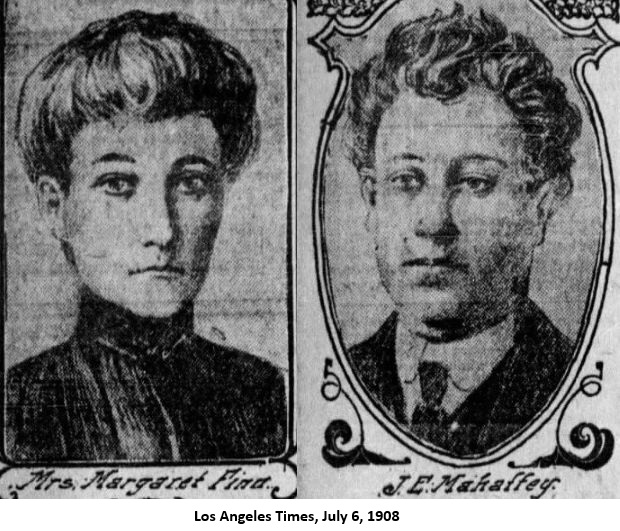
On July 5th, 1908, Maggie Finn shot Jesse Edwin Mahaffey (1876-1908) to death at Seventh street and Broadway in Los Angeles just after 8 o'clock in the evening.
Maggie was introduced to J. E. ("Ed") Mahaffey by his brother, W.H. Mahaffey. W.H. lived and worked in Los Angeles and had been known by her. In January of 1908, Ed came to Los Angeles from Indiana, where he was born in 1876. Maggie quickly became attracted to him and they became engaged by the end of January. They planned to be married in March. However, as the marriage date neared, Ed began to have second thoughts. He kept postponing the wedding. On the July 5th, Mahaffey came to her apartment in the evening and formally separated with her. She had been sick all day with a bad headache. Maggie's brother James G. Lang was also at Maggie's room by her request. After Mahaffey left, Maggie asked her brother to go after him and try to get him to reconsider. The two men talked for a while. Maggie came out from her room and saw Mahaffey begin to walk away. She approached him, drew her revolver and fired two shots at his back. Mahaffey was killed almost instantly. Her brother James disarmed her, she collapsed, and he carried her into a nearby drug store. Lang then telephoned for an ambulance and notifed the police. Maggie was taken to jail. Mahaffey was taken to the morgue. There it was determined that at least one of the bullets entered the back between the shoulder blade and penetrated the lungs.[24]
Maggie told her story from the jail, which was printed in multiple newspapers in slightly different versions. The following is from the Los Angeles Evening Express of July 6, 1908:
"I met Ed - so she speaks of Mahaffey, who was 32 years old - last January. He proposed to me about two weeks afterward. I wanted to be married on my birthday, May 3, but he preferred his birthday which fell on March 19, I believe. His birthday came and he postponed the wedding for two weeks, giving lack of funds as his reason. For awhile I said nothing, but later I asked him several times what he intended to do about it, but he never gave me a satisfactory answer and often he said he did not want to talk about it. I wrote him a letter June 24, asking him again what he intended to do. He came to see me and said he had received the letter. I asked him what he intended to do. He said he did not know what he would do. Yesterday I had asked him to go to Eastlake park with me. He came up about noon and then I told him that I had seen an advertisement in the paper in which someone was wanted to do chamber work, and that we would see about that and then go to the park. Then came a phone call from his aunt, and he said he would go to see her and his uncle, with whom he lived at 241 West Forty-seventh street.
Again I asked him his reason for wanting to postpone our marriage. He had said before that he had no money, but as he was a painter and paperhanger and I knew he was making good money lately. I asked him this time if he had been married secretly to anyone else or anything like that. He said no - he had never been married. Then I intended to shoot myself and I went to my trunk and unlocked it and took my revolver from it. He took it from me as I was trying to shoot myself and went away, taking the revolver and the key to my room with him. Later I telephone to him, telling him to bring back the razor of my dead husband that he had borrowed, as I wanted to sell it to buy food, and also to return my suitcase, as I wanted to use it. He had borrowed that, too. Finally I telephoned to my brother, J.G. Lang, who came up in the evening.
I was telling him about my troubles when the landlady's bell rang and as she had gone out, leaving me in charge, I went to answer it. At first I saw no one, but then I noticed Ed almost crouching in the doorway leading into the landladys room. When he saw me threw the suitcase down and said, 'here's your suitcase. Goodbye.' I tried to get him to go into the room where my brother was, but he refused He accused me of having tried to shoot him in the afternoon and said 'You'll never get a chance to shoot me.' Then he started away. I went back into the room and I am almost sure that I told my brother to follow him. Anyway, he left and I opened the suitcase. It contained the razor, a ring of mine which he was wearing until he got enough money to buy me one for our engagement, my picture and the revolver. When I saw the ring and the picture I knew that he was through with me and I hastily tore open the paper with which he had wrapped the revolver and found that he had unloaded it, but left the cartridges in the paper with it.
I looked out the window and saw my brother talking with Ed on the street. I thought my brother might need that revolver, and so I loaded it and putting it in my purse I think I went down the stairs. When I arrived I saw Ed turn away with what looked like a contemptuous wave of the hand. Then I remember raising the revolver, but not aiming at anything in particular. They say I fired twice, but I didn't remember anything more until I was brought to the police station, except I think my brother grabbed me by the arm. If I had stopped to think a minute I wouldn't have done it, and am very, very, sorry. I don't know what I shall do. I have no money with which to hire an attorney."
Another statement she made was:[25]
"That man was duty bound to marry me. Outside the obligations attending our engagement, there were physical obligations which any man of honor would have observed. He had sworn to hold sacred the trust I had placed in him, but he violated that trust. I did not mean to kill him - only to scare him. I fear the consequences only for my little children."
Why was he duty bound to marry her? That was made clearer in the Los Angeles Times of July 7, 1908:
"Not until four months ago did I tell him of my condition. He told me then not to worry, that he would see that everything was all right. Then when he came to me Sunday night [the 5th] and threw me over, and I realized the awfulness of my condition, everything seemed to turn black. I did not know what was going to happen when I ran out of that place with the revolver. I thought I might scare him. And then it happened. I can remember seeing him fall and the people rush toward me, but I do not know how it happened."
Her "condition" was that she was pregnant by Mahaffey with her 4th child. Without him, she would be a single mother with four children and little means of support. In those days, it was the duty, but not legal duty, of Mahaffey to marry the mother of his child. An unmarried woman with four children would have a difficult life.
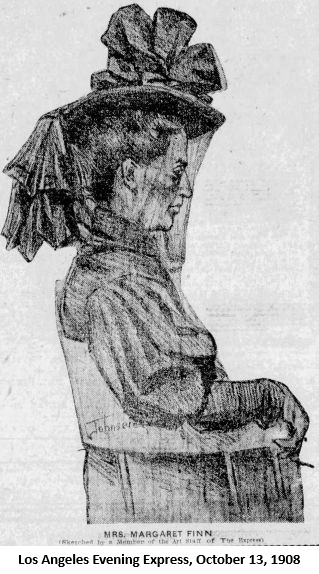
On July 8th, the coroner's jury found that Mahaffey was killed by Margaret Finn by a gunshot wound, but they were unable to determine whether or not the shooting was justifiable or not. They did not want to take up the so-called unwritten law of the right of a woman to avenge her honor. Her brother James testified in front of the jury and said "he considered his sister justified in shooting down the man who had wronged her under the guise of friendship and promises of an early marriage, and who had then jilted her." Her attorney Fred Thompson said that "his client stands upon the unwritten law and that he does not think her case will get beyond the lower courts."[26] The next day Thompson said that insanity will be the defense of Mrs. Finn. He did not say what kind of insanity. He would not contest that fact that Finn killed Mahaffey, but that she was justified. He was "satisfied that she really did not know what she was doing when she shot him." It was also reported that her two brothers (William and James) would pay all her trial expenses.[27]
On the 10th, it was reported that the defense would be that she had temporary emotional insanity, due to her condition at the time of the shooting, combined with the "unwritten law."[28] A day later, James G. Lang, Margaret's brother, petitioned the court to appoint him the guardian of her three children.[29]
Still in the county jail, on October 12th, Maggie plead for someone to provide a good home for her two boys (Lang - age 12 and Daniel - age 9) until she could take them back. They were currently living with her 71 year old mother Mary Lang, but she was becoming too old to care for them. Maggie's daughter (Margaret - age 13) was already living in a good home.[30]
A preliminary hearing in front of a judge would be held to decide whether she would stand trial or not. The hearing got started by taking testimonies from witnesses. The drug store clerk said that Mrs. Finn had severe headaches and frequently purchased bromo-seltzer from him. "She frequently complained that these headaches caused her to become almost insane." When she was brought into the store after the shooting, he noted her peculiar indifference and believed that she was insane when she fired the fatal shots.[31] Other witnesses testified including J.E. Mahaffey's brother, W.H. Mahaffey, who had originally introduced her to J.E.[32]
The Times of October 13 revealed what everybody probably already knew, Maggie was pregnant. "Mrs. Finn will soon become a mother. In the dim cell of the County Jail she awaits the arrival of the little one. Her trial may have to be postponed on account of its birth and sympathy for the woman is manifested by all who know her, including the officials who hold her in custody."[33]
When the preliminary hearing continued on the 13th, one of the officers testified that although he saw a small wound in the back of Mahaffey, he could not swear that it was caused by a bullet. Many witnesses said that the shooter was Mrs. Finn. Another witness said that the defendant acted as one in a stupor, half asleep and not realizing what she was doing. By the end of testimony for the day, the prosecution could not prove that Mahaffey died because of a bullet shot by Mrs. Finn mainly because the doctor who performed the autopsy on Mahaffey's body was out of town.[34]
On the 14th, some spectators cried after hearing a letter from Mrs. Finn to Mahaffey. Several times she wrote that she would be driven to insanity if he left her. Several witnesses testified that she was insane when she shot Mahaffey. A witness named Bernard Masterson testified that she was insane at the time of the shooting based on the wild-eyed appearance of her and of her actions. Reporter Daniel Green saw her at the police station when she was brought in and said she was wild-eyed and did not appear to be rational. The prosecution was still having problems in proving the cause of death since the doctor was still out of town. The judge would not postpone the hearing to wait for the doctor to return to Los Angeles. The defense moved to dismiss the case because it was not possible to show that the bullets fired by Mrs. Finn killed Mahaffey. The judge denied that motion. The police surgeon testified that when he saw Mrs. Finn the night of the shooting she was in a dazed condition, with dilated eyes, and did not seem to know what was going on. In his opinion, she was not sane on the night of the murder. The first officer at the scene of the shooting testified that he thought that Mrs. Finn was insane.[35]
To no one's surprise, on the afternoon of Friday the 16th, Mrs. Margaret Finn was found not guilty on the grounds that "she was not mentally responsible on the night that she shot Mahaffey. She is hereby discharged and the case dismissed." Also, she would not be called before a lunacy commission because, while insane at the time of the shooting, she was mentally competent now.[36]
Edith Evelyn Lang, the daughter of Maggie and Ed Mahaffey, was born on December 5, 1908.[37] Edith would die on July 5, 1978.
Maggie's father, John Lang, died on January 20, 1909.
On the 1910 US Census[38], the widowed Margaret Finn, was living with her now four children - Margaret (15), Lang (14), Daniel (11), and recently born Edith (1).
Maggie's mother, Mary, died on May 2, 1911.
For about a year, police patrolman William G. Cramer had been paying close attention to Maggie Finn, according to her 19 year old daughter Margaret in 1914. She said that Cramer had known her mother for the past 5 years and had claimed that he wasn't married. Cramer was a night patrolman and, according to the daughter, would sometimes visit while he was drunk and in uniform. Sometimes he also slept there and Maggie would walk his beat and ring in his alarms (to prove he actually working). Maggie gave Cramer an amethyst ring which would give him good luck, happiness and prosperity as long as he wore it. If he didn't, Maggie claimed that the curse of the "amethyst god" would fall heavily on him. However, Cramer gave the ring to his wife (or she found it), who he was living with along with his four children. In January of 1914, he suddenly broke off the relationship. Maggie then wrote him a letter stating that she was unable to believe that he would be false to her and that she would end her life unless he proved that he had not deserted her. He evidently didn't prove himself because on the night of January 26, 1914, Maggie attempted suicide by shooting herself in the breast at her home. The bullet only made a flesh wound on her left breast and she would recover. However, the officer was suspended in disgrace to await further disciplining from the board of police commissioners. He had been in trouble before.[39]
On the 1920 US census[40], Margaret Best used her first husband's last name. Living with her was Evelyn (11) - the middle name of Edith, Lang (34), Daniel (20), and Margaret Gildea (24), her already widowed daughter.
Margaret Lang Best Finn died of breast cancer on January 25, 1921.[41] She was only 47 years old, but had experienced a full lifetime of tragedies.
Sources:
Main source was newspapers.com. Also ancestry.com and familysearch.org for census, birth, death, and marriage records.
[1] "I wanted to be married on my birthday, May 3,..." - Los Angeles Evening Express, July 6, 1908. Her birth date was also listed on her 1921 Death Certificate.
[2] Los Angeles Evening Express, October 15, 1908; Los Angeles Times, October 16, 1908; Los Angeles Herald, October 17, 1908.
[3] Arizona Marriages, Best to Lang, Marriage License and Certificate, March 19, 1892.
[4] Mohave County Miner, April 16, 1892; Description of Convict George W. Best, Territorial Prison at Yuma, Arizona Territory.
[5] 1870 U.S. Census, Berkshire, Tioga County, New York.
[6] Great Register, Pima County, Arizona, 1889.
[7] Arizona Marriages, Richmond to Lang, Marriage License and Certificate, March 14, 1892.
[8] Arizona Territorial Prison at Yuma, List of Prisoners, from the year 1876 to 1895, Compiled by William H. Haught, p. 185. Found at the Arizona Memory Project website.
[9] Coroner's Verdict, April 15, 1893, Arizona, U.S., County Coroner and Death Records, 1881-1971, Ancestry.com; Arizona Weekly Journal-Miner, April 19, 1893.
[10] Los Angeles County Marriages, Marriage Certificate, Best to Finn.; Los Angeles Herald, January 1, 1895. Los Angeles Evening Express, January 3, 1895. Los Angeles Times, January 6, 1895.
[11] Year listed incorrectly as 1858 on his Death Certificate. The 1860, 1870, & 1880 US censuses all show that the birth date was 1853 or 1854. His marriage certificate to Maggie indicated an age of 40, which would make his year of birth 1854.
[12a] State of New Hampshire, Certificate of Marriage, John Finn to Rosana Malony, October 18, 1873, Ashuelot, New Hampsire. New Hampshire, Vital and Town Records Index, 1656-1938, at familysearch.org.
[12b] Case No. 14037, Divorce, Superior Court, Los Angeles, California. Case documents found at the Huntington Library, San Marino, California. Los Angeles Area Court Records, 1850-1911, Superior Court, Second Era. Complaint transcribed by me (actual document hard to read), here.
[13] Los Angeles Times, December 19, 1892; Los Angeles Herald, November 20, 1894: "J.J. Finn, general yardmaster of the Southern Pacifice company, testified as follows: 'I have been yardmaster for 13 years...'"
[14] Los Angeles Times, January 9, 1895.
[15] Los Angeles Herald, January 3, 1895.
[16] Los Angeles Evening Express, January 4, 1895.
[17] 1898 Helena City Directory.
[18] 1900 United States Census.
[19] 1903 Los Angeles City Directory.
[20] Los Angeles Evening Post Record, October 4, 5, 8, 10, and 12.
[21] California State Board of Health, Bureau of Vital Statistics, Duplicate Certificate of Death.
[22] Fitchburg (Mass.) Sentinel, December 29, 1906; Los Angeles Evening Post Record, December 29, 1906; Los Angeles Times, December 31, 1906.
[23] Fitchburg (Mass.) Sentinel, Fitchburg (Mass.), Sentinel, March 29, 1907.
[24] Los Angeles Herald, July 6, 1908; Los Angeles Times, July 6, 1908.
[25] Los Angeles Evening Post Record, July 6, 1908.
[26] Los Angeles Times, July 8, 1908.
[27] Los Angeles Evening Express, July 9, 1908.
[28] Los Angeles Herald, July 10, 1908; Los Angeles Times, July 10, 1908.
[29] Los Angeles Herald, August 12, 1908; Los Angeles Evening Express, August 11, 1908.
[30] Los Angeles Evening Post Record, October 12, 1908.
[31] Los Angeles Evening Post Record, October 12, 1908; Los Angeles Times, October 13, 1908.
[32] Los Angeles Evening Express, October 13, 1908; Los Angeles Evening Post Record, October 13, 1908.
[33] Los Angeles Times, October 13, 1908.
[34] Los Angeles Evening Express, October 14, 1908; Los Angeles Herald, October 14, 1908; Los Angeles Times, October 14, 1908.
[35] Los Angeles Evening Express, October 15, 1908; Los Angeles Herald, October 15, 1908; Los Angeles Times, October 15, 1908.
[36] Los Angeles Evening Post Record, October 16, 1908; Los Angeles Herald, October 17, 1908; Los Angeles Times, October 17, 1908.
[37] California State Board of Health, Duplicate Certificate of Birth, Edith Evelyn Lang, December 5, 1908.
[38] 1910 U.S. Census.
[39] Los Angeles Times, January 27, January 28, 1914; Los Angeles Evening Express, January 27, 1914; Santa Barbara Morning Press, January 29. 1914; Oakland Tribune, February 8, 1914.
[40] 1920 U.S. Census.
[41] California State Board of Health, County of Los Angeles, City of Los Angeles, Standard Certificate of Death, Margaret May Finn, January 25th, 1921.