Did Andres Pico Successfully Refine Oil for the San Fernando Mission in the 1850's?
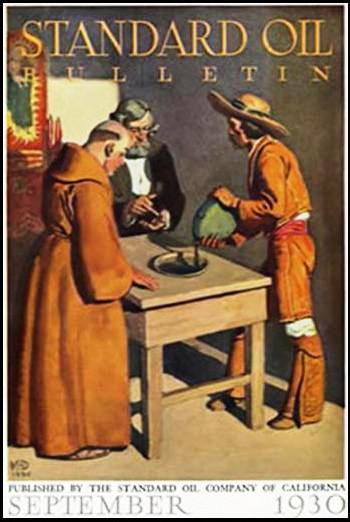
Cover from the Standard Oil Bulletin of September, 1930, showing a priest, Andres Pico, and a caballero. The problem with that picture is that no priests were living at the mission at that time. The last resident priest, Fr. Blas Ordaz, had left in 1847(Engelhardt, San Fernando Rey, the Mission of the Valley, Ballena Press, Ramona, California, 1973, p.117.). Andres Pico had leased the mission property in 1846 from his brother Pio, then the governor of California.
There is no evidence, only legends, that Andres Pico ever refined oil for the San Fernando Mission in the 1850's. The earliest reference to this story that I could find is from the Fourth Annual Report of the State Mineralogist for the Year Ending May 15, 1884, California State Mining Bureau (p. 294). It says:

(Morrell's first refinery was in 1857.) No source is given for this statement, but it seems to be the source for every future refining story.
In a 2011 California history book the story is stated as:
The first recorded use of oil from this area was in 1850 when Andres Pico, Mexican general and brother of Pio Pico, the last Mexican Governor of California, collected seepage in Pico Canyon, several miles west of US 6, and distilled it in a copper still and worm to obtain petroleum for the lamps at San Fernando Mission.
Between 1884 and 2011, almost all books that I have checked have more or less the same Pico story with different embellishments. Interestingly, most start out with "it is said that" or "there is a legend" - nothing very certain.
For example, one says (from 1907): "It is said that Andreas Pico used to supply the priests at San Fernando mission with oil from Pico Canyon." From a 1964 book: "Pico sold the oil to nearby San Fernando Mission, in very small quantities." There were no priests living at the mission after 1847.
The Alton, Illinois, Evening Telegraph of March 12, 1913, says "Mr. Morrell, a druggist in San Francisco, is commonly credited with being the first to attempt the distillation of kerosene from crude petroleum. This was in 1857, but several years prior to that Andreas Pico made illuminating oil from petroleum which he obtained in the Newhall region in Los Angeles county. This oil was burned, so it is said, in lamps in the Mission San Fernando." So it is said.
From the Overland Monthly magazine of July-December 1915 comes this great embellishment by M.C. Frederick:
In the early fifties - authorities differ as to the exact date - Pico collected this oil and distilled it in a copper still and worm, making burning oil for the Mission, where there may have been seventy-five or a hundred souls, all told. This included the retainers with which every well-to-do Californian loved to surround himself, Mexicans employed on the ranch, and Mission Indians who still lingered after the Fathers departed, some too young to be of service, but all welcome to remain.
The source given was "Petroleum in Southern California", 1913, by Paul Prutzman (California State Mining Bureau Bulletin 63) on page 159, where it says "As early as 1850 Andreas Pico had been collecting seepage oil, which he distilled with a copper still and worm, making burning oil for the San Fernando Mission." Prutzman's source was obviously the 1884 Fourth Annual Report. Frederick did some filling in between the lines.
In 1925, W.W. Orcutt wrote "There is a legend from the San Fernando Mission to the effect that in 1855 General Andreas Pico and his nephew, Romulo Pico, took oil for experimental and refining purposes from the seepages and hand-dug pits in the canyon near Newhall which bears their name."
From 1974: "A quarter of a century earlier, in 1850, Andres Pico had taken oil from seeps in Pico Canyon in Newhall and distilled it into kerosene he called "burning oil" to light the dark rooms of the San Fernando Mission where he lived." Burning oil? There was no source for this statement.
"The Black Bonanza" by Earl Welty and Frank Taylor made some un-substantiated statements. There were at least two editions of the book. In the first edition of 1950, they wrote:
"Two Mexican prospectors, General Andreas Pico and his nephew Romulo, were digging pits unnoticed in a canyon north of San Fernando Mission in Southern California. From these pits the Picos scooped up a black, sticky tar which they sold at the mission for healing and illuminating uses."(page 1) "General Pico likewise was motivated by the belief that 'fossil oil' would cure man's aches and light his nights."(page 2)
If they had done their research, they would have found out that Andreas Pico was living at the Mission by 1846 and the padres were gone by 1847. In the second edition of 1956 & 58 they expanded on their first edition.
"Yet old records reveal that, several years before the Drake Well was drilled, two enterprising Spanish Californians, Andreas and Romulo Pico were gathering 'brea,' as they called the sticky tar seeping into pits they dug in Southern California, and cooking the stuff at San Fernando Mission to boil off lamp oil and make axle grease."(page 1) "About 1855, General Andreas Pico, brother of Pio Pico, the last Mexican governor of California, set up a crude still at San Fernando that extracted axle grease, lamp oil, and medicine oil from the tar he and his nephew hauled out the hills near Newhall."(page 20)
What "old records" were they talking about? Why didn't they tell us? Both editions have no sources and have no bibliography.
However, there are two sources written by two different men with very similar claims. William W. Jenkins (1835-1916) writes in the "History of the Development of Placer Mining in California" (from Annual Publication of the Historical Society of Southern California, Volume VII, 1906, p. 71) that "in 1854 W.W. Jenkins and Sanford Lyon, at the instance of and with Francisco Lopez, visited the oil springs, from whence the Mission San Fernando took the oil in rawhide bags to the mission where it was distilled for lighting purposes." He did not say what oil springs or who distilled it.
And then there is "The True History of the First Discovery of Gold in California in 1842" by Francisca Lopez de Belderrain published in 1930. She quotes from Cyrus Lyon's "Daily report." This document is evidently lost. The report says: "In 1854 Don Francisco Lopez took me, Cyrus Lyon, and my brother, Sanford, to an oil spring from which the Padres of San Fernando Mission carried the oil in raw-hide bags to the Mission, where it was distilled for lighting purposes."
These two statements are suspiciously similar. The only difference is who went with Sanford to the oil springs, which was not named. The distiller was also not named. They did not claim that they collected any oil, only visited the site. The padres had done the collecting. The problem with that is by 1854, there were no priests (or padres) living at the mission. The last priest (Ordaz) had left in 1847, about seven years previously.
The following story is from the Daily Alta California of February 21, 1865. Here Andres Pico is finally documented testing crude oil from presumably Pico Canyon. If he had already successfully refined oil in the 1850's, then why would he be testing in 1865? If the oil he distilled burned better than Downey's oil (a popular burning oil at the time), than why didn't he start his own oil company business? Probably because because it was not as easy as that and the refined product was not as good as was reported. For most of the next decade, refined oil was almost always claimed to burn better than Eastern oil, which was never true. Early refiners always had problems refining California oil.
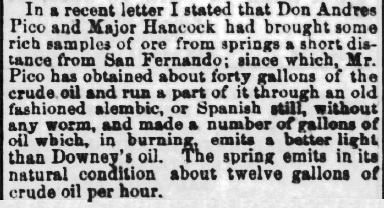
There is also a similar story from the Sacramento Daily Union of March 31, 1865:
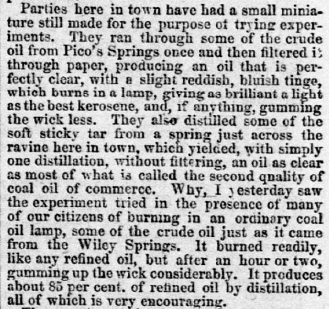
If Pico was already the "pioneer" refiner, then why wasn't he showing them what to do?
The Wilmington Journal of February 10, 1866, reported that Dr. Vincent Gelcich stopped at the San Fernando Mission on the evening of January 30th 1866, with the express intent of visiting the oil regions. He met with Andres Pico and spent the night there. Gelcich, who was always excited about the oil prospects of the region, mentioned nothing about the refining of oil or using oil for lighting at the mission. If it really was happening or had happened, Gelcich would certainly have been very interested.
J.E. Pleasants spent a week at the mission in 1856 as a boy. He wrote a 13-page description of his stay which can be read
here (PDF 1.4MB).
This is an excerpt:
He lived in a luxurious style and had a large household of trained servants, chiefly Indians. Like the grandee that he was, he entertained lavishly. His silver and china table service made a brilliant display. His household furnishings were plain but massive and luxurious. The plain old mission furniture was retained but many an expensive and more ornate piece had been added. His table afforded an ample style of living; the dinners consisted of five to six courses - all of the far-famed California-Spanish cookery, which no nation - not even the French, has ever excelled. Two young Indian boys served as waiters. They were clad in the simple tunic of Andres, at the head of the table and said grace, and at the close of the meal, the other took his place and returned thanks. At the mid-day and evening meals, and on the veranda in the evening, we were delightfully entertained by native musicians who played on three stringed instruments then mostly in vogue - the harp, violin and guitar.
There is no mention of how the room was lit. Surely, the unique use of refined oil for lighting would have been reported by a visitor. I also checked many other books and newspaper articles of this period mentioning Pico or the mission and none of them said anything about refining oil at the mission.
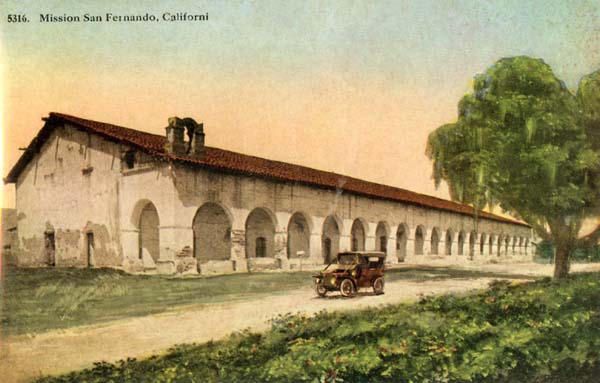
San Fernando Mission
In 1968, Gerald T. White in his "Scientists in Conflict - The beginnings of the Oil Industry in California" finally cast doubts on the tale:
Long after the oil industry in California had become a reality, a few tales were told of experiments in oil refining as early as the middle 1850's by various southern Californians. The best known of these concerns Don Andres Pico, who, it is claimed [in the fourth report of 1884], tapped the oil springs of Pico Canyon in the Santa Susana Mountains as early as 1855 and "made oil for the San Fernando Mission ...in a copper still and worm." The truth is that the mission was by this time in ruins, except for a building Andres occupied. The last Franciscan padre had left the premises nearly a decade before. It is highly doubtful that such experiments actually occurred, and if any did, it was merely as a small-scale, isolated episode.
In 1984 W.H. Hutchinson in his book "California, The Golden Shore by the Sundown Sea" came to the same conclusion:
There is a claim that Andres Pico distilled petroleum into illuminating oil at Mission San Fernando as early as 1854-55. Extensive research into the beginnings the oil industry in California does not confirm this story, and it seems best to consign it to the realm of folklore.
The San Fernando Mission was famous for its olive trees and wine. They did have stills for making wine, brandy, and olive oil. Olive oil is a dark color similar to refined oil and actually can be burned for light. Maybe someone confused olive oil for refined oil.
So, did Pico successfully refine crude oil at the San Fernando Mission (or anywhere) before 1865? No.