The Lyon Brothers


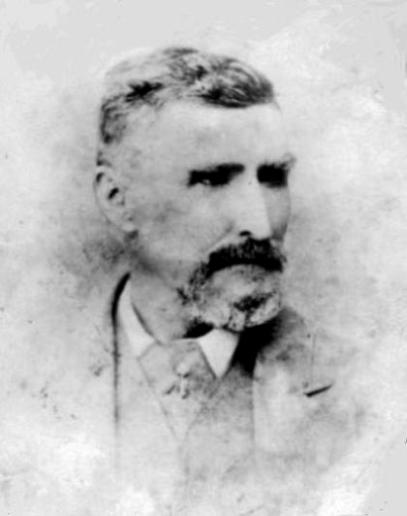
Cyrus Lyon

Copyright Note: This image is NOT in the public domain
and is protected by the copyright laws of the United States.
Used by permission of Victoria Norton.

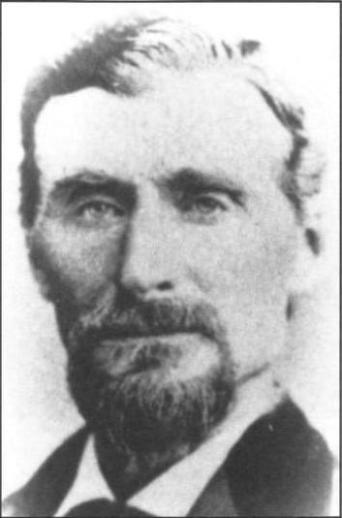
Sanford Lyon


Cyrus and Sanford Lyon were twin brothers born on November 20, 1831 in Machias, Maine. Their parents were Henry and Betsy Lyon (see the Eight Generations of Lyon webpage here). In 1849, they sailed to San Francisco from Nantucket around Cape Horn on the ship "Oxnard." They soon made their way south to Los Angeles and worked as clerks for (David W.) Alexander & (Francis) Mellus, a merchantile store. Francis and Henry Mellus were first cousins to the Lyons. Alexander & Mellus brought goods around Cape Horn, exchanging them for hides and tallow (a form of beef or mutton fat). A few years after the Mexican War (1846-48), they went out of business.

Horace Bell
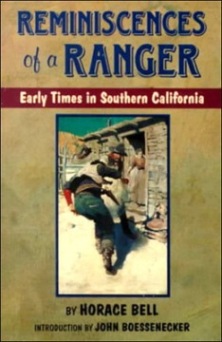
In 1853, the Los Angeles Rangers were formed by the Alcalde (or mayor) of Los Angeles Don Ignacio del Valle. Some of its members were Horace Bell, William Reader, William W. Jenkins, and Cyrus Lyon. Cyrus became quite well known and well respected. In the 1881 book "Reminiscences of a Ranger" by Major Horace Bell (which can be read here ) Bell shows his respect:

Of our gallant comrade, Cyrus Lyon, the language of the immortal Byron can be well applied:
"Of all our band,
Though firm of heart and strong of hand,
In skirmish, march, or forage, none
Can less have said or more have done."

Victoria Carrillo Norton, a great, great, granddaughter of Cyrus, has kindly provided me with family information and scans pertaining to Cyrus and has checked over the accuracy of my statements on this and the Lyon family webpage. (Of course, I am responsible for any errors that still may exist.) Thanks Vickie. She has also donated a "Lyon Family Album" to the Santa Clarita Historical Society. In her December 2007 "My Ancestors" story on the Somos Primos website Vickie writes:
Cyrus Lyon stayed mainly in Los Angeles. With all the lawlessness in the pueblo of Los Angeles, a strong law enforcement group was needed to keep order. The Los Angeles Rangers were appointed by Don Ignacio del Valle, the mayor of Los Angeles to put a stop to the disorder. Cyrus Lyon at 21 yrs old was appointed a captain under Horace Bell and was one of their most efficient rangers.

Cyrus Lyon also followed first cousin Francis Mellus and partner David Alexander’s lead in becoming one of the first Americans to own property in the San Fernando Valley and Los Angeles. During the 1850’s he owned property in Rancho Cahuenga, Rancho Los Feliz, and Rancho Providencia. It was during this time that Cyrus became the father of Jose Enrique "Henry" Lyon. Henry’s mother was Nicolasa Triunfo who was descended from the Basilio Rosas family, one of the original eleven families that settled the Pueblo of Los Angeles in 1781. Nicolasa Triunfo was the daughter of Jose Miguel Triunfo who was an ex-San Fernando Mission Indian born around 1810. He had been granted Rancho Cahuenga by Mexican Governor Manuel Micheltorena in 1843 for services performed at the Mission. He traded this property with Francisco and Pedro Lopez a few years later for Rancho Tujunga. Francisco Lopez is the same individual that discovered gold in Placerita Canyon in 1842. Jose Miguel Triunfo was one of the few Indians that were able to obtain and keep property. His wife, Maria Rafaela (Canedo) Arriola was a "Gente de Razon", that being a member of the established Christian community. Miguel and wife Rafaela can be found in the 1850 census of Los Angeles.
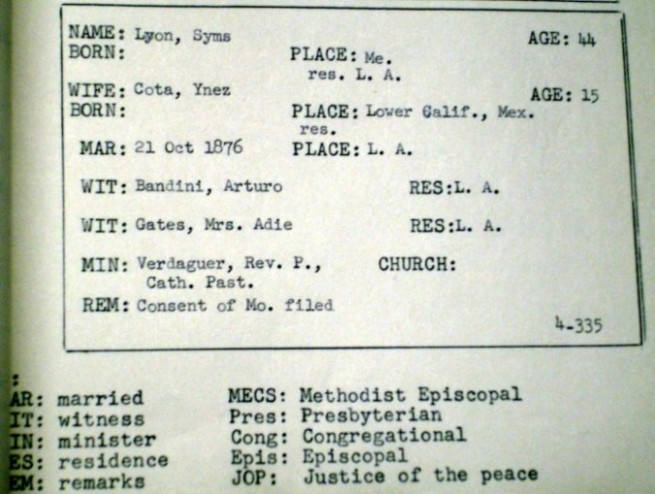
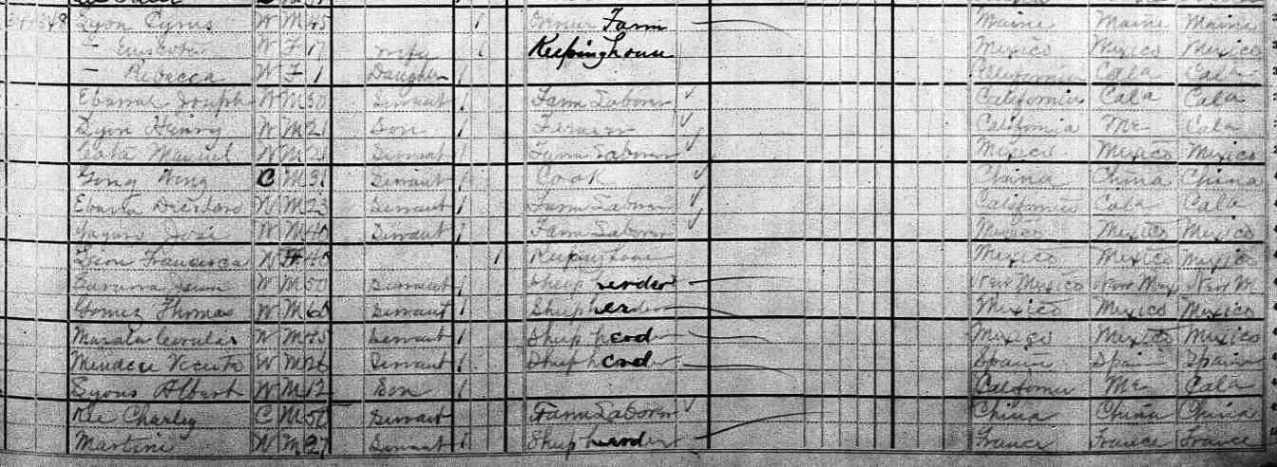
No marriage record between Cyrus and Nicolasa Triunfo has been found. Their sons Henry and Albert Lyon were considered "hijo naturales" because their parents were not married in the church. Cyrus was apparently also involved with Matilda Ortega, with whom he had two children. On the 1880 US Census, 48-year old Cyrus is married to 19-year old Ynez Cota and have one child, Rebecca. The census taker first wrote down "daughter" as Ynez's relationship to Cyrus, but crossed that out when he realized his mistake.

Cyrus would eventually have 11 children with Nicolasa, Matilda, and Ynez. He was evidently a responsible parent because all his children were given the Lyon last name, even the ones where there was no official marriage. See the
Lyon family webpage here for a list of his children.


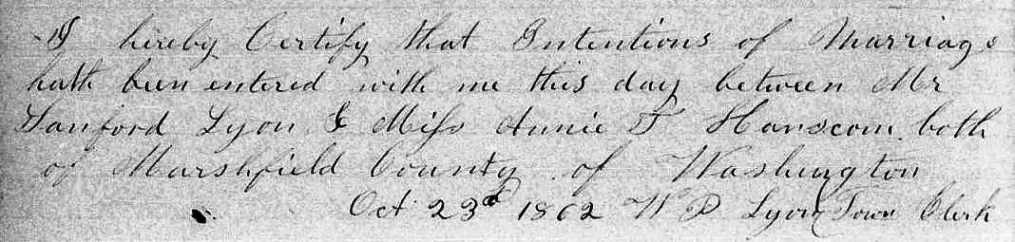
Church record of the October 21, 1876, marriage of 44-year old Cyrus (badly misspelled) and 15-year old Ynez

Copyright Note: This image is NOT in the public domain and is protected by the copyright laws of the United States.
Used by permission of Victoria Norton.


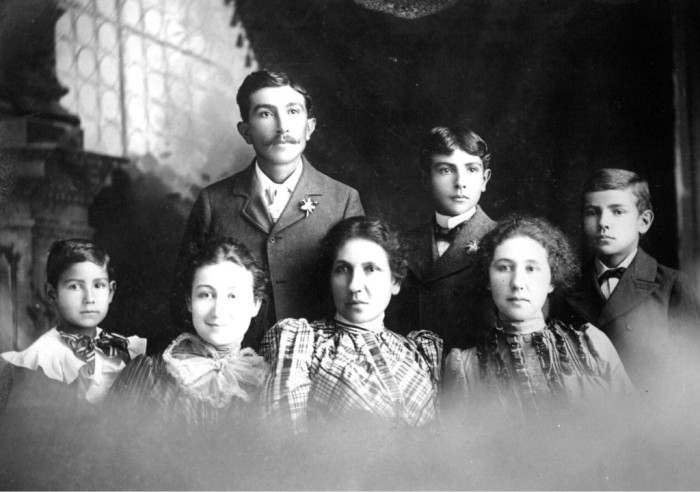
The family of Cyrus around 1900. Top row left to right - Albert (mother Nicolasa Triunfo), Cyrus A., Robert. Bottom row left to right - Arthur E., Alice, Ynez Cota (mother of the others), and Rebecca.

Copyright Note: This image is NOT in the public domain and is protected by the copyright laws of the United States.
Used by permission of Victoria Norton.


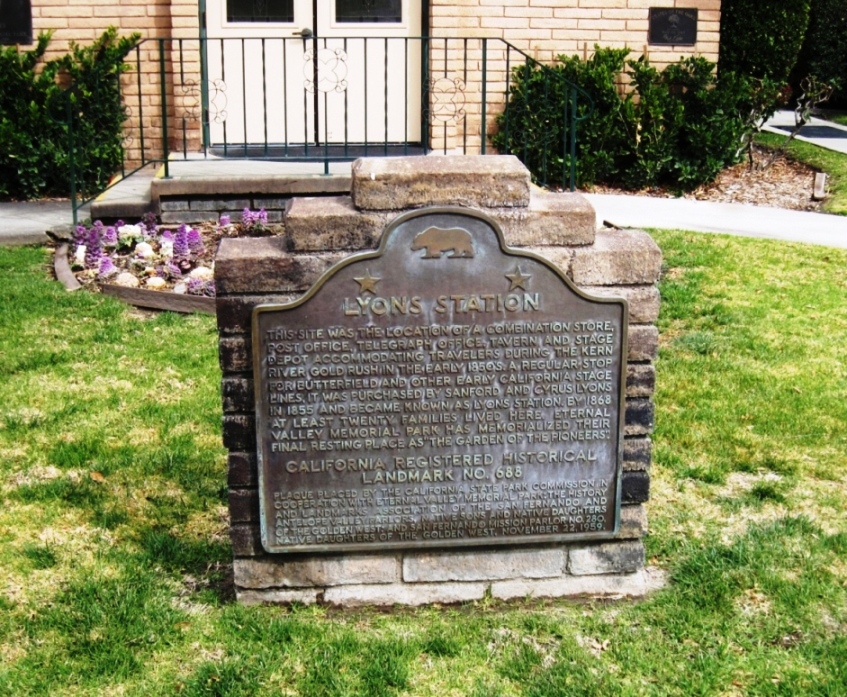
Lyon's Station marker at the Eternal Valley Memorial Park in Newhall, California.

Lyons Station
This site was the location of a combination store,
post office, telegraph office, tavern and stage
depot accommodating travelers during the Kern
River gold rush in the early 1850's. A regular stop
for Butterfield and other early California stage
lines, it was purchased by Sanford and Cyrus Lyons
in 1855 and became known as Lyons Station. By 1868
at least twenty families lived here. Eternal
Valley Memorial Park has memorialized their
final resting place as "the Garden of the Pioneers".

California Registered Historical
Landmark No. 688

Plaque placed by the California State Park Commission in
cooperation with Eternal Valley Memorial Park; The History
and Landmarks Association of the San Fernando and
Antelope Valley Parlors, Native Sons and Native Daughters
of the Golden West; and San Fernando Mission Parlor No. 280,
Native Daughters of the Golden West, November 22, 1959.


By 1856, the brothers owned what would be called Lyon's Station and the land around it. Besides running the station, they farmed and raised sheep. In "Sixty Years in Southern California" by Harris Newmark, Newmark writes for 1856:
During the summer, I had occasion to go to Fort Tejón to see George C. Alexander, a customer, and I again asked Sam Meyer if he would accompany me. Such a proposition was always agreeable to Sam; and, having procured horses, we started, the distance being about one hundred and fifteen miles.

We left Los Angeles early one afternoon, and made our first stop at Lyons's Station, where we put up for the night. One of the brothers, after whom the place was named, prepared supper. Having to draw some thick blackstrap from a keg, he used a pitcher to catch the treacle; and as the liquid ran very slowly, our sociable host sat down to talk a bit, and soon forgot all about what he had started to do. The molasses, however, although it ran pretty slowly, ran steadily, and finally, like the mush in the fairy-tale of the enchanted bowl, overflowed the top of the receptacle and spread itself over the dirt floor. When Lyons had finished his chat, he saw, to his intense chagrin, a new job upon his hands, and one likely to busy him for some time.

Departing next morning at five o'clock we met Cy Lyons, who had come to Los Angeles in 1849 and was then engaged with his brother Sanford in raising sheep in that neighborhood. Cy was on horseback and had two pack animals, loaded with provisions. “Hello, boys! where are you bound?” he asked; and when we told him that we were on our way to Fort Tejón, he said that he was also going there, and volunteered to save us forty miles by guiding us over the trail. Such a shortening of our journey appealed to us as a good prospect, and we fell in behind the mounted guide.

It was one of those red-hot summer days characteristic of that region and season, and in a couple of hours we began to get very thirsty. Noticing this, Cy told us that no water would be found until we got to the Rancho de la Liebre, and that we could not possibly reach there until evening. Having no bota de agua handy, I took an onion from Lyons's pack and ate it, and that afforded me some relief; but Sam, whose decisions were always as lasting as the fragrance of that aromatic bulb, would not try the experiment. To make a long story short, when we at last reached the ranch, Sam, completely fagged out, and unable to alight from his horse, toppled off into our arms. The chewing of the onion had refreshed me to some extent, but just the same the day's journey proved one of the most miserable experiences through which I have ever passed.

The night was so hot at the ranch that we decided to sleep outdoors in one of the wagons; and being worn out with the day's exposure and fatigue, we soon fell asleep. The soundness of our slumbers did not prevent us from hearing, in the middle of the night, a snarling bear, scratching in the immediate neighborhood. A bear generally means business; and you may depend upon it that neither Sam, myself nor even Cy were very long in bundling out of the wagon and making a dash for the more protecting house. Early next morning, we recommenced our journey toward Fort Tejón, and reached there without any further adventures worth relating.

Coming back, we stopped for the night at Gordon's Station, and the next day rode fully seventy miles-not so inconsiderable an accomplishment, perhaps, for those not accustomed to regular saddle exercise.

A few months later, I met Cy on the street. “Harris, said he, “do you know that once, on that hot day going to Fort Tejón, we were within three hundred feet of a fine, cool spring?” “Then why in the devil,” I retorted, “didn't you take us to it?” To which Cy, with a chuckle, answered: “Well, I just wanted to see what would happen to you!”


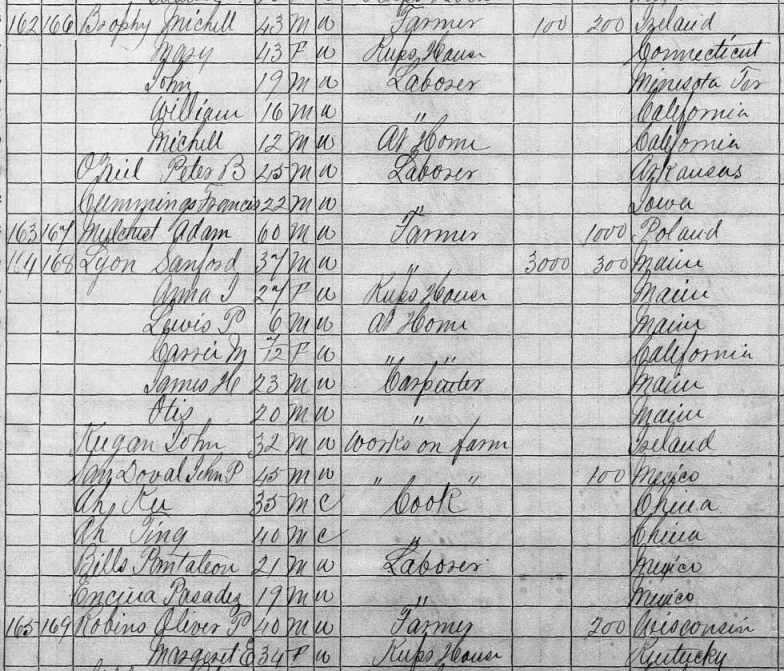
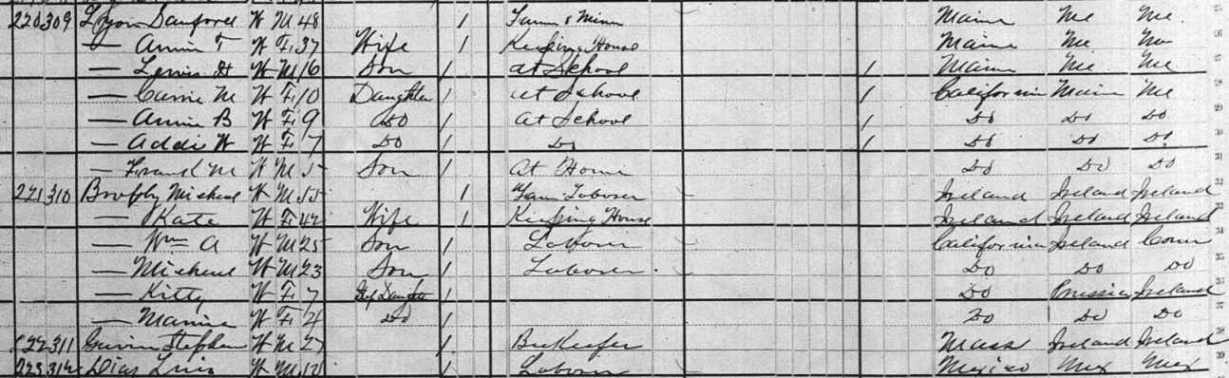
On the 1860 census, Sanford and Cyrus are living together in the Los Angeles Township under the Los Angeles Post Office. A.B. Perkins reports that an Los Angeles County Handbook and Directory listed 20 heads of families at Lyon's Station. The 1870 census shows Sanford (I could not find Cyrus on this census) in the Los Angeles Township but this time at the Petropolis Post Office. This must be the Petroleopolis Post Office which operated from 1867-1871. Lyons Station was also called Petroleopolis probably starting around 1867. Christopher Leaming was appointed the first postmaster on April 1, 1867. Richard N. Hosmer was appointed on November 21, 1867. Sanford Lyon was then appointed on July 23, 1869 (from early postmaster appointments in LA county). The 1870 census also shows Lyon's wife Anna.


William W. Jenkins writes in the "History of the Development of Placer Mining in California" (from Publications of the Historical Society of Southern California, Volume VII, Annual Publications of 1906-1907-1908) that "in 1854 W.W. Jenkins and Sanford Lyon, at the instance of and with Francisco Lopez, visited the oil springs, from whence the Mission San Fernando took the oil in rawhide bags to the mission where it was distilled for lighting purposes." That oil springs was in Pico Canyon.

In the same article, Jenkins also writes that "in the year 1858, W.W. Jenkins and Cyrus Lyon purchased from Jose Espenosa one nugget from which was realized $1,928, which was the largest piece known to have been taken from this locality." That locality was either the San Feliciana, Castaic or the San Francisquito placer field.

In 1869, Sanford Lyon, with Henry Hancock and a Lockwood, dug a spring-pole well in Pico Canyon to 140 feet. The claim was held by Robert F. Baker and E. F. Beale. There is no evidence that either of the Lyon brothers ever filed their own claim in Lyon Canyon or anywhere else.

Besides oil, Sanford also had other mining interests. From the Signal August 5, 1954, The Story of Our Valley by AB Perkins
Land office records for May 1870 for patent applications:

George Gleason, Sanford Lyon, Alexander DeWitt and George J. Clark, know as "Lyon Mining Co." - apply for 1800 feet on the Lyon Lode, land and water privileges, Township 4N, R12W San Bernardino meridian, in the Gleason district.

George J. Clarke, George Gleason, H. H. W. Clarke, Sanford Lyon, Christopher Leaming, Benjamin C. Truman, ask for 1000 feet on the Eureka lode in the Soledad mining district.
The Los Angeles Daily News of March 27, 1872 reports that in Petroleopolis the Owens Valley earthquake of March 26, 1872 was severely felt and the Daily Alta of the same date reported that clocks stopped.

In 1874, Beale, Baker, and Andres Pico formed the Los Angeles Petroleum Refinery Company and built an unsuccessful refinery at Lyons Station. It was shut down in 1875 and in 1877 the parts were moved about a mile westward to Andrews Station where a larger refinery was being built.

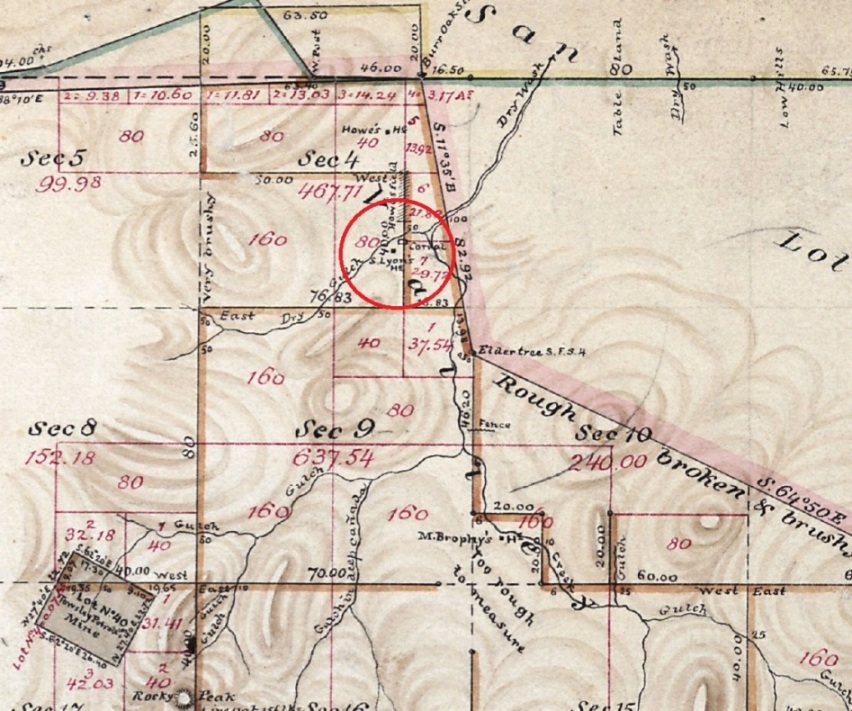
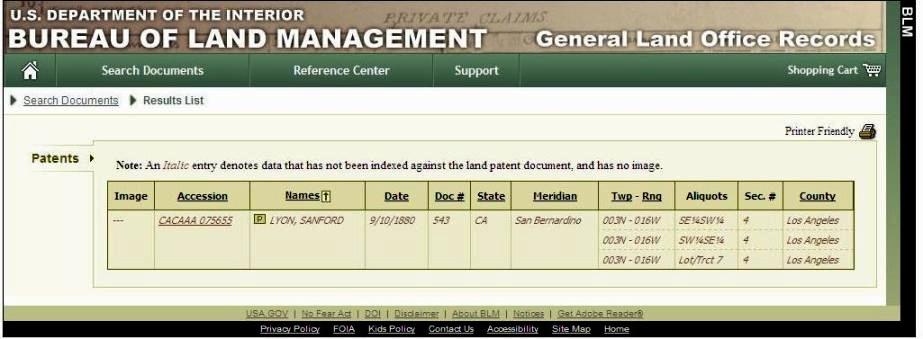
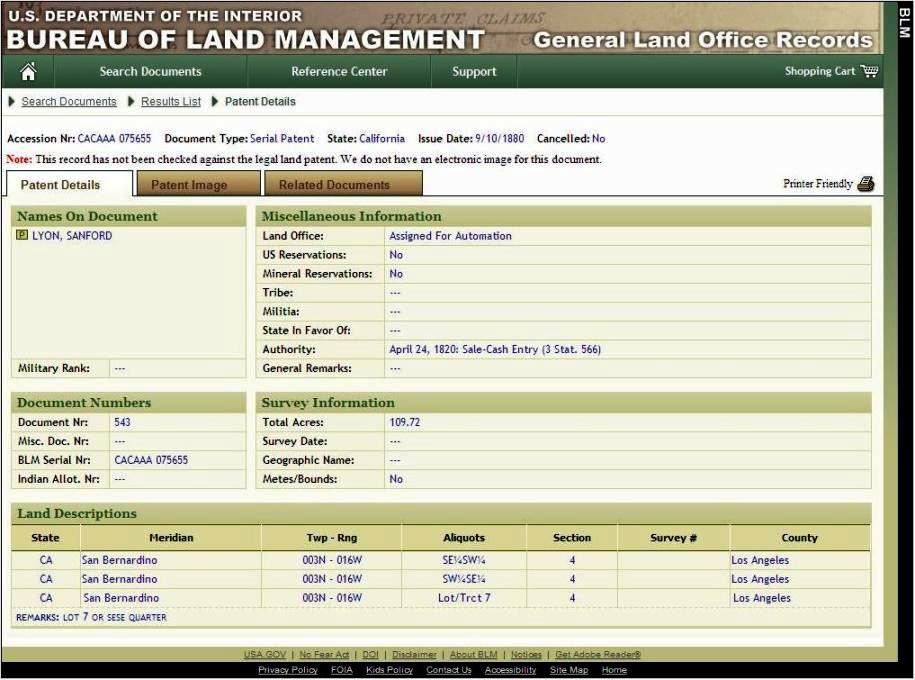
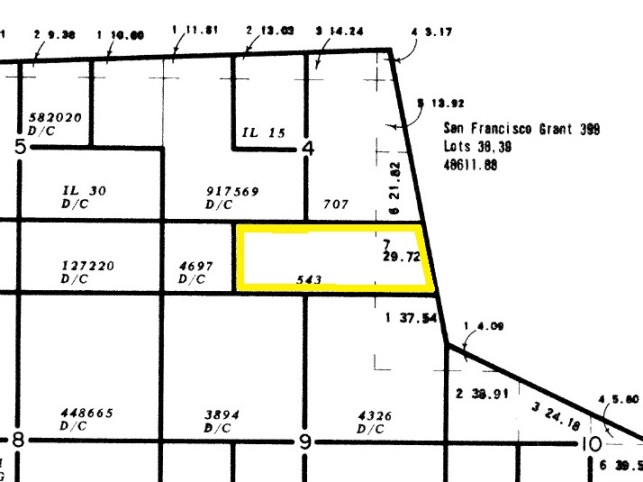
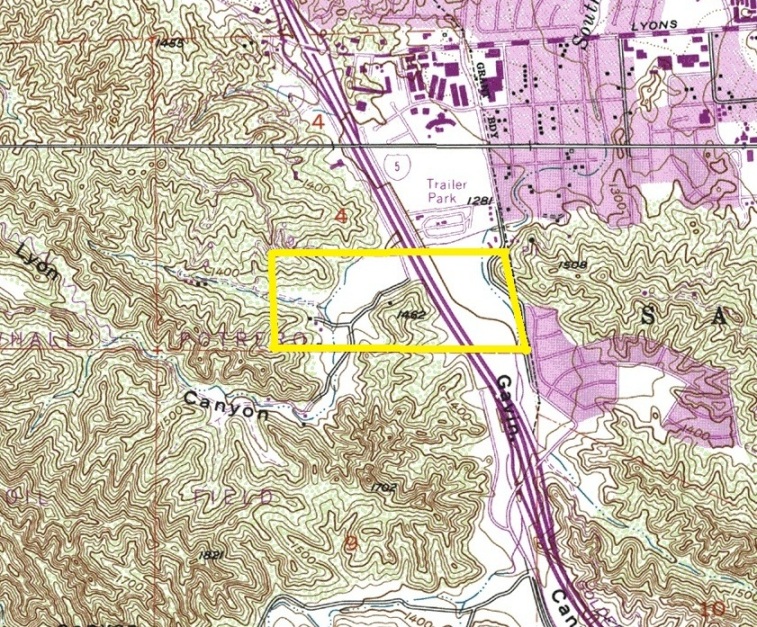
On 9/10/1880, Sanford Lyon purchased about 110 acres for cash at the mouth of today's Lyon Canyon from the federal government, probably providing the canyon its future name.

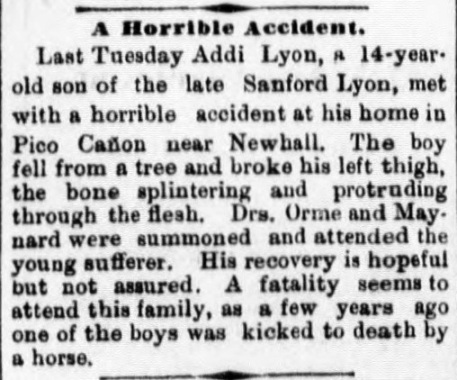
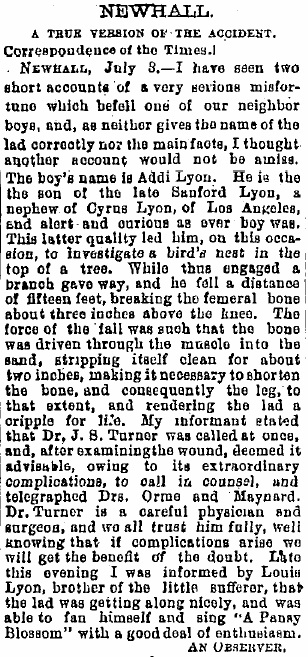
Sanford and Anna would eventually have six children. See the Lyon family webpage here for a list of Sanford's children.


Sanford Lyon died on November 30, 1882, at the age of 51. He is buried at the Eternal Valley Memorial Park in Newhall, California, which is located just behind the supposed location of Lyon's Station.

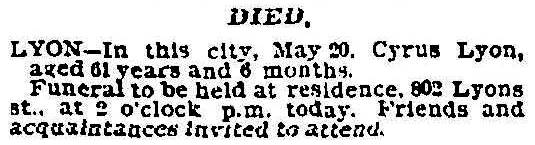
Ten years later, Cyrus Lyon died on May 20, 1892, at the age of 61 in Los Angeles. He is buried at the Evergreen Cemetery in Los Angeles, California.

On 9/10/1880, Sanford Lyon purchased 110 acres for cash at the mouth of today's Lyon Canyon (from this BLM/GLO land patent search page)


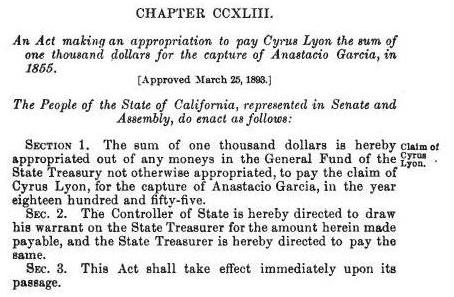
In 1893, the state of California passed an act to pay Cyrus Lyon $1000 dollars for the 1855 capture of Anastacio Garcia. Unfortunately, Cyrus died in 1892. Whether his widow Ynez received the money is unknown.


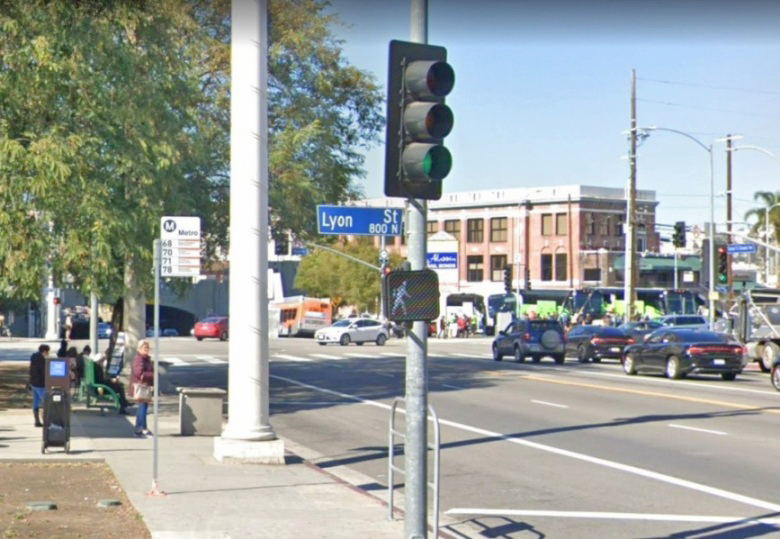
Lyon Streen in Los Angeles was named for Cyrus Lyon. In 1953, Pico Road in Newhall was changed to Lyons Avenue by the County of Los Angeles Surveying Department. Whether they meant to name it for Sanford Lyon and mistakenly added the "s" is not known. I'd like to believe that they meant both Sanford and Cyrus.

Copyright Note: This image is NOT in the public domain and is protected by the copyright laws of the United States.
Used by permission of Victoria Norton.


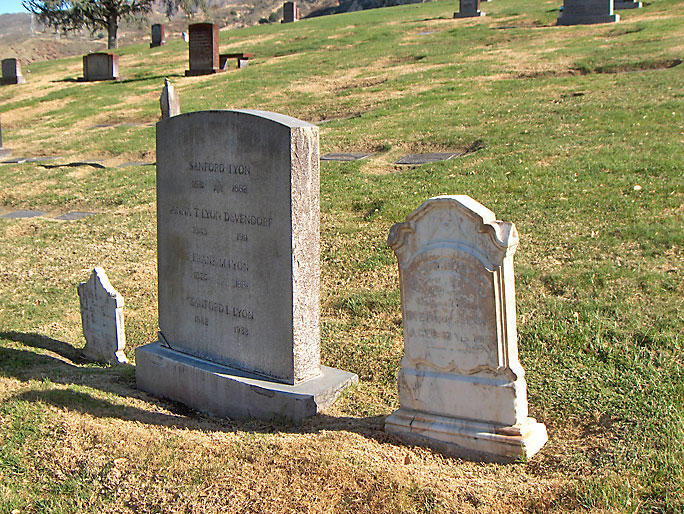
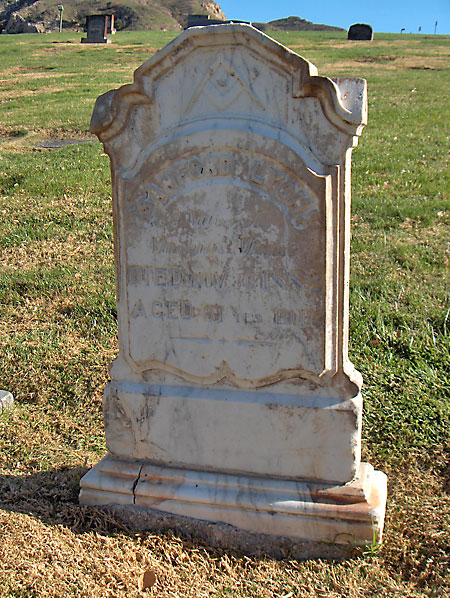
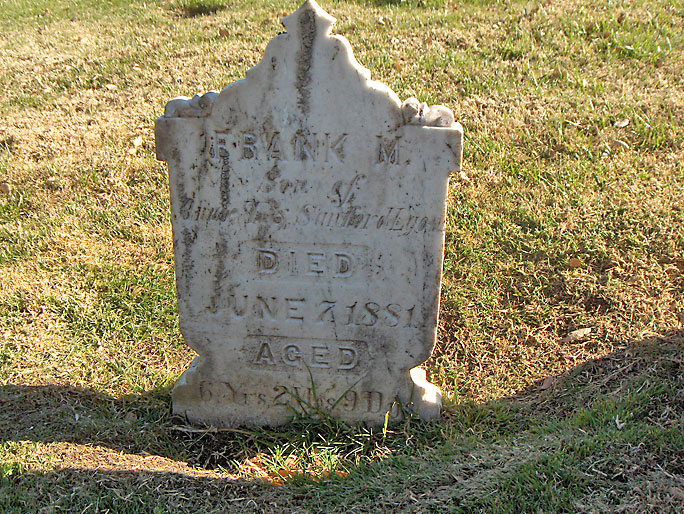
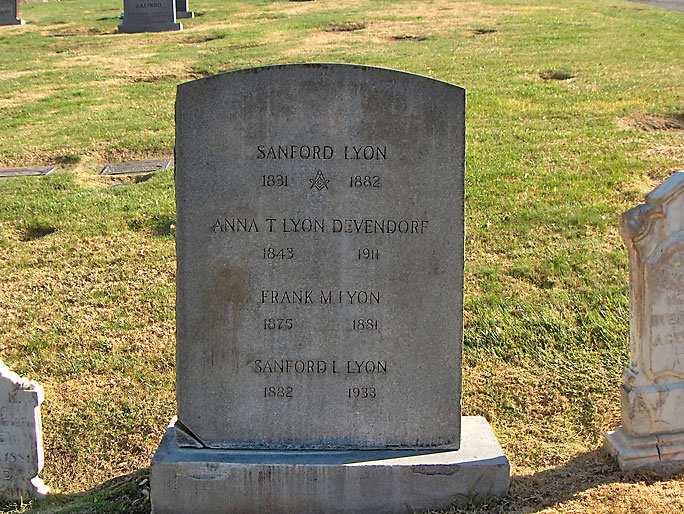
Here is the Sanford Lyon gravesite at the Eternal Valley Memorial Park in Newhall, California. This cemetery is right behind the long-gone site of Lyon's Station on Sierra Highway. This is location 124-D in the Garden of the Pioneers.


The gravestone on the right of the above photo is Sanford Lyon's marker. It says:

Sanford Lyon
A Native of
Machias Maine
Died Nov 30 1882
Aged 51 Yrs 10 Ds


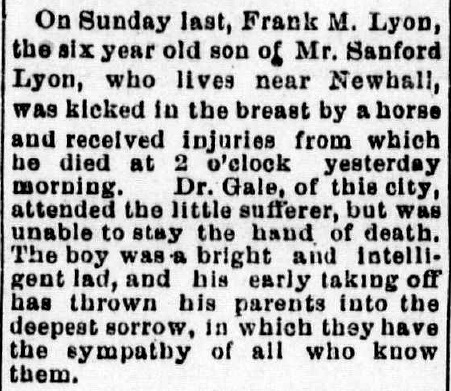
The small gravestone on the left tells a sad story:

Frank M
son of
Annie T and Sanford Lyon
Died
June 7 1881
Aged
6 Yrs 2 Mos 9 Dys


The larger stone in the middle says:

Sanford Lyon
1831 - 1882
Anna T. Lyon Devendorf
1843 - 1911
Frank M Lyon
1875 - 1881
Sanford L Lyon
1882 - 1933


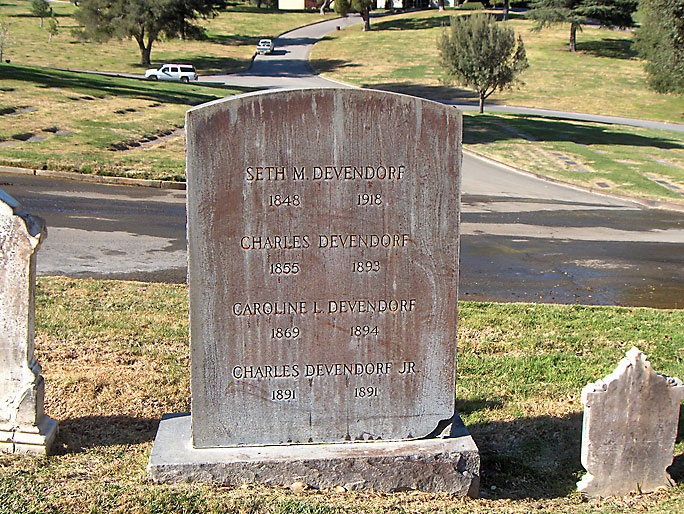
The back of the larger stone shows that this is also the resting place of Annie's second husband Seth and some of his family. They were married around 1885.

Seth M Devendorf
1848 - 1918
Charles Devendorf
1855 - 1893
Caroline L Devendorf
1869 - 1894
Charles Devendorf Jr
1891 - 1891


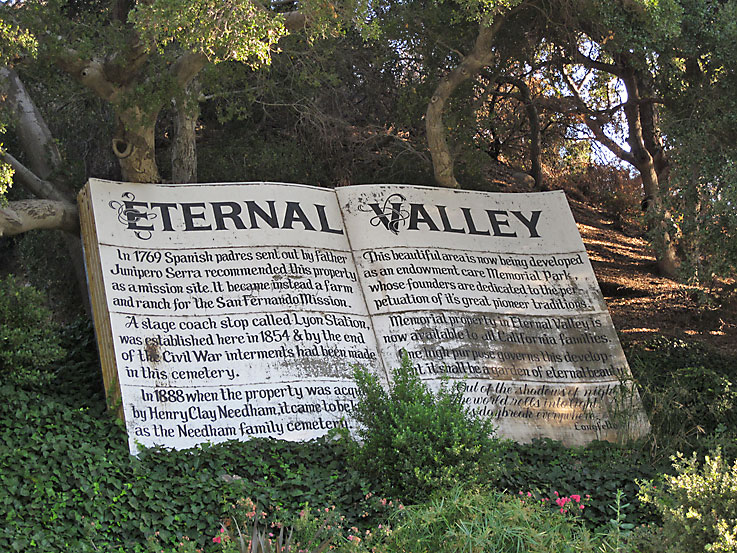
Large sign in front of the Eternal Valley Memorial Park in Newhall, California. About Lyon Station it says:

A stage coach stop called Lyon Station,
was established here in 1854 & by the end
of the Civil War interments had been made
in this cemetery.


Cyrus Lyon died on May 20, 1892 in Los Angeles ten years after his brother Sanford died.


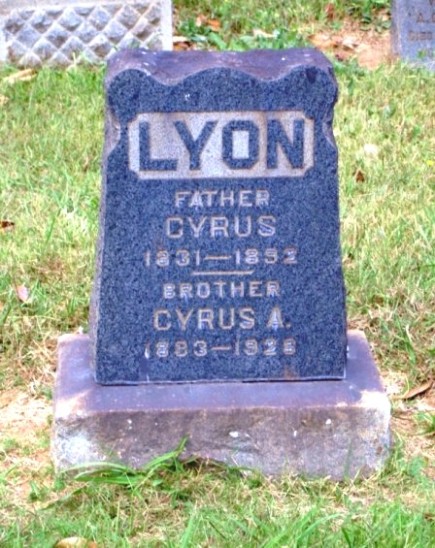
The grave marker of Cyrus Lyon (11/20/1831 - 5/20/1892) in Evergreen Cemetery in Los Angeles, California. Family oral history says that his son Cyrus A. (1883 - 12/25/1926) was cremated and his urn was buried in his father's grave

Copyright Note: This image is NOT in the public domain and is protected by the copyright laws of the United States.
Used by permission of Victoria Norton.


Return