Waltz, Santa Clarita, California
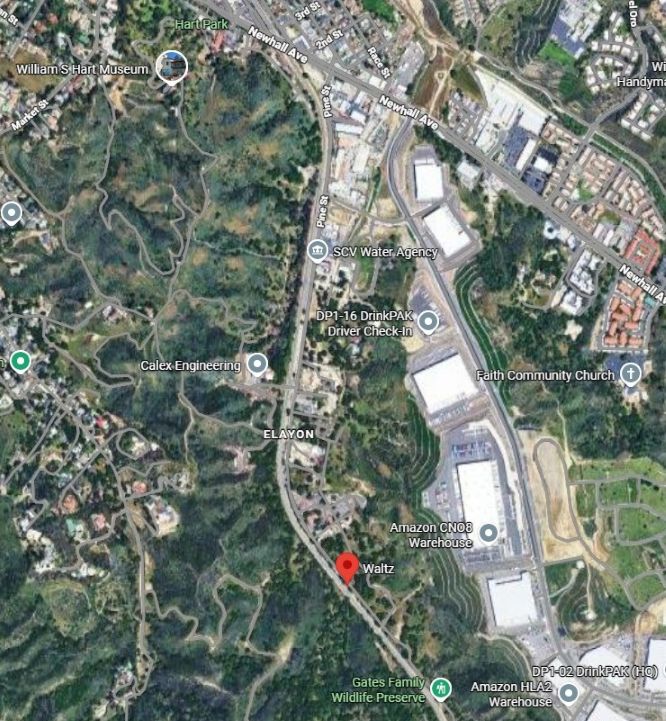
Google maps aerial view showing Waltz.
Shown on many maps is the old railroad stop of Waltz. It was on Pine Street south of Newhall and south of Elayon. (On the above map, Elayon is incorrectly located. Elayon should be further north just above the SCV Water Agency marker, which is just east of the Pioneer Oil Refinery.)
If you are riding the railroad today, you see no Waltz or any indication that there ever was a Waltz. So what was Waltz? The following drawings will show you.
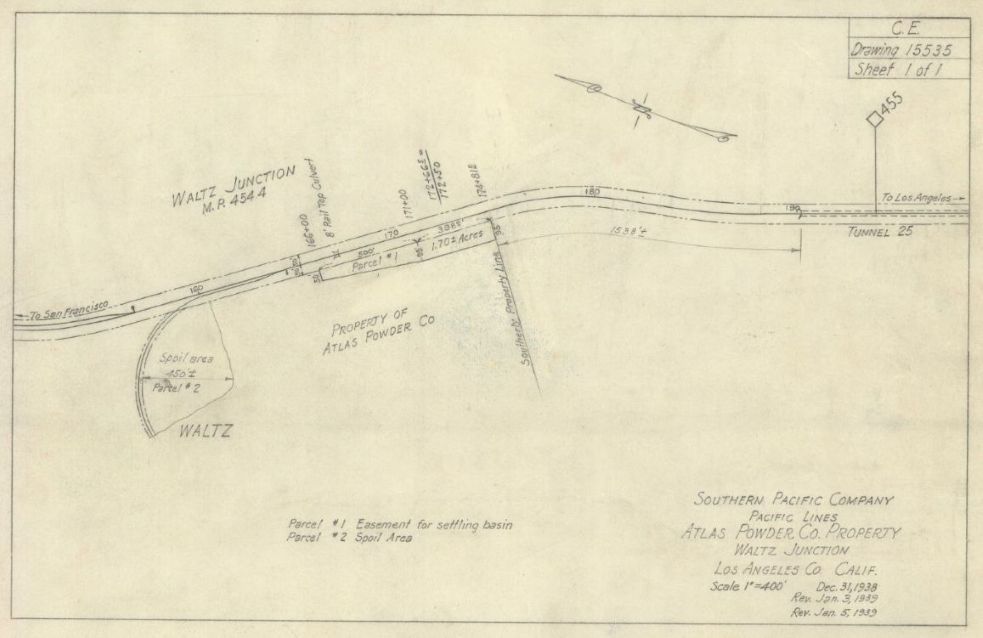
1938, 1939 Revision diagram of Waltz Junction and Waltz. Technical Drawing Number CE 15535, Record ID 206091, California State Railroad Museum Library & Archives, Sacramento, California.
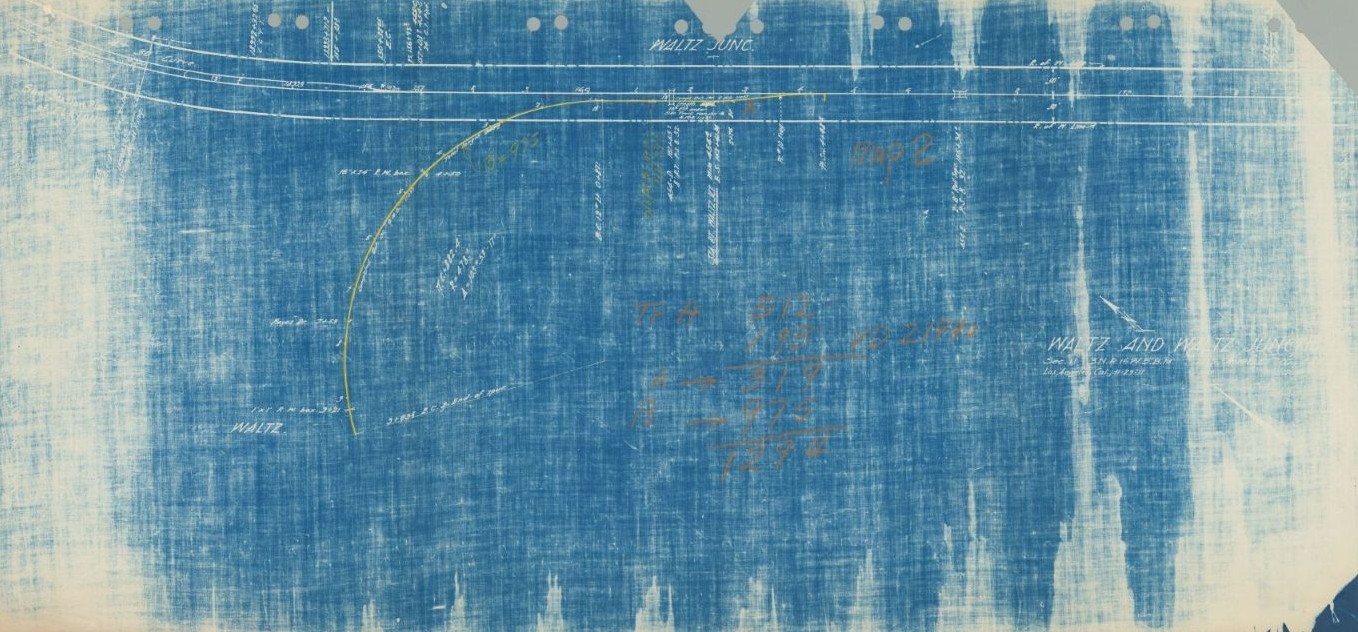
Diagram of Waltz Junction and Waltz dated November 29, 1911. Technical Drawing, Record ID 205732, California State Railroad Museum Library & Archives, Sacramento, California.
Waltz was located on a railroad spur which began at Waltz Junction on the west side of the tracks. Today, on the east side of the tracks opposite to the long-gone spur, is the entrance into the Gates Family Wildlife Preserve, which is the beginning of a public hiking trail. For vehicles, this is at the southern end of Pine Street. Only hikers are allowed to continue on from here.
No one lived in Waltz. It was a magazine owned by the Atlas Powder Company. A magazine is a highly secure, specialized container or structure designed to safely store explosive materials, such as dynamite, propellants, and detonators. Only Atlas used the spur for loading or unloading gunpowder, dynamite, and maybe nitroglycerin. Atlas must have contracted with the Southern Pacific railroad to have the spur built. The SP probably decided on the name "Waltz", although the name "Atlas" would have seemed more appropriate. Documentation for Waltz is sparse. The above drawing, done soon after the spur was completed, notes that Southern Pacific General Managers Orders (GMO) 11097 dealt with the spur. The CSRM has some of those in their Southern Pacific Company Records collection, but the GMO's for Los Angeles are not available yet.
The above drawing also says that the spur started at Mile 454.4 (the distance to San Francisco via train), was completed in October of 1911, and had a total length of 1294 feet.
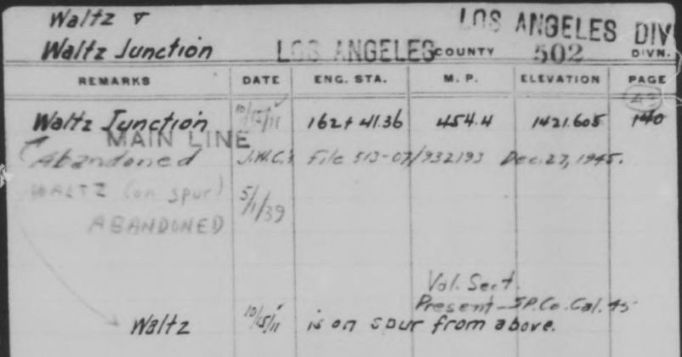
Southern Pacific Railroad Station Card. From the Internet Archive Digital Library. Their source - Reel 2: SP Railroad Cards, Index L-Z, California State Railroad Museum Library & Archives, Sacramento, California.
The station card indicates that construction was finished on October 15, 1911. The card also says that the spur was abandoned on May 1, 1939. Serpico also agrees with the 1939 date. However, the abandonment of the spur did not mean that the Atlas magazine was also closed. It wasn't. The December 27, 1945, date pertained to the J.W.C.'s File 513-07/932193. I do not know what the JWC abbreviation stands for.
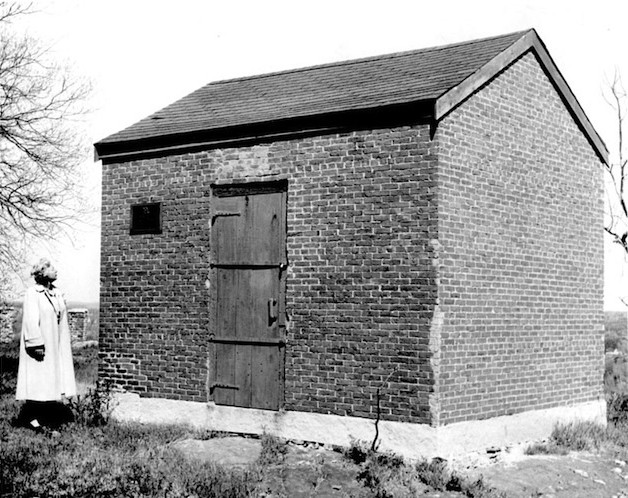
Hallowell, Maine, 1820 magazine.
There are no known photos of the Waltz magazine. However, it probably resembled the one in the above photo, but was larger. Based on estimated measurements from old aerial photos, I believe that the building was a rectangle about 30 feet long and 15 feet deep. It was made of brick, like the above one, and had no windows. An April 24, 1952, Newhall Signal article reported that someone had tried, but failed, to break into the "brick structure" to steal explosives. They had tried chiseling into the brick wall and the door. If there had been a window, that would have been attacked, too.
Ralph Emerson Galbreath was born in Ohio in 1871 and died in Missouri in 1954. He had come to California around 1915 and became a landscape gardener. Moving to Newhall in 1923, he became a representative for the Atlas Powder Company and managed the Atlas Powder Magazine in Waltz. He also was a farmer, a rancher and a gardener. Voter registrations from 1928 until his death listed his residence on Pine Street. After 1936, the actual address was listed as 646 Pine Street. Up to the 1950 census, he was single, but the 1950 census showed him married to Lillian S. Barrett (b. 1877 in England), his housekeeper on the 1940 census. In 1952, he reported a robbery attempt at the Atlas magazine he was still managing showing that the magazine was still active 13 years after the spur was abandoned. There was a road directly to the magazine from Pine Street over the railroad tracks, so access was never an issue. In 1954, while visiting relatives in Missouri, he died at the age of 83. (Newhall Signal, February 7, 1952; April 24, 1952; July 15, 1954.)
After Galbreath, there is no more news of the Waltz magazine. An aerial photo from 1968 is not clear, but the magazine may have still been there. However, an aerial photo from 1974 appears to show that the magazine was gone. The footprint of the stucture is partially visible today (2026) and there is a small pile of broken bricks and concrete at the site (see photos). There is no evidence of the spur. Erosion and plant growth have done their job. If you didn't know where spur was, you would not recognize that there ever was one.
I could not find any information about the formation of the Atlas Powder Company. However, Atlas powder was advertised as early as 1878 (Green Bay Advocate, August 29, 1878). Atlas powder was a variety of explosive. It would be reasonable to assume that the Atlas Powder Company came up with the formula for that explosive. Atlas powder was advertised as "The most powerful and safest blasting material yet invented."(Dade County Advocate, Greenfield, Missouri, 6/10/1880.) The first report of the Atlas Powder Company that I could find was in The Daily Item of Lynn, Massachusetts, of June 5, 1881. However, the company had obviously been around for many years by then.
In 1895, the DuPont Powder Company, owned by T. Coleman DuPont, purchased controlling interest in the Repauno Chemical Company, the Atlas Powder Company, the Hercules Powder Company and the Giant Powder Company. DuPont basically controlled all of the major powder companies in the United States. In the 1900s, the Federal government finally got legally involved to force the DuPont "powder trust" to break up. This would occur in 1912 when the new Atlas Powder Company (and the others) was re-incorporated in Wilmington, Delaware. By then, of course, Waltz and Waltz Junction had been built.
Atlas would soon begin to branch out into manufacturing a variety of chemicals. In 1961, Atlas merged with the Stuart Company, a west coast drug firm, and became Atlas Chemical Industries, Inc. By then, they had probably quit manufacturing powder. In 1972, the company was merged with ICI of America, Inc., a subsidiary of Imperial Chemical Industries, Ltd. The combined company was named ICI America Inc. The Atlas name was gone. In 1993, Imperial Chemical Industries split itself into two companies. The company unit that included ICI America would be named Zeneca Ltd. In 1999, Zeneca purchased Astra, Sweden's largest pharmaceutical company, and they became AstraZeneca, which still exists today.